

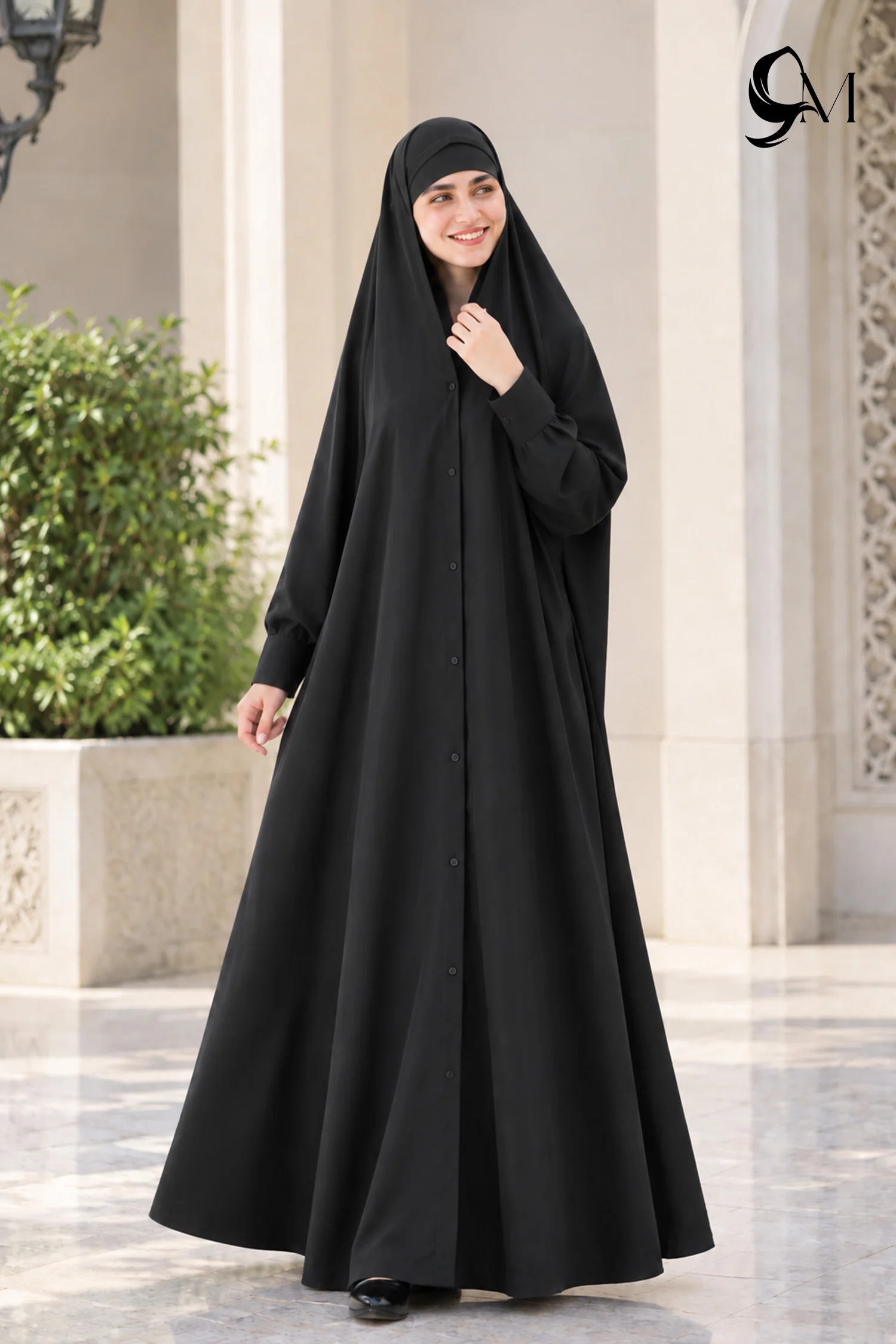
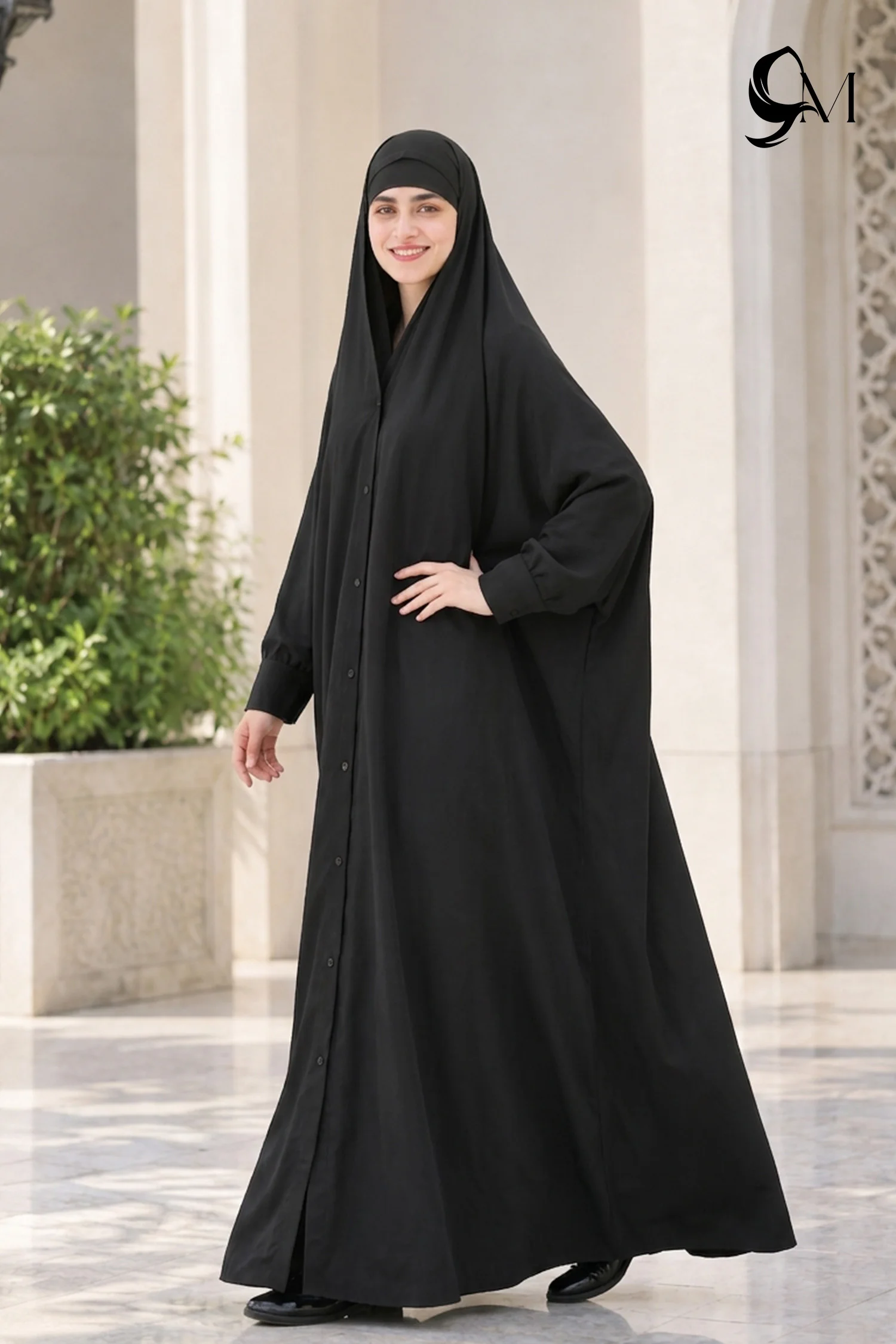
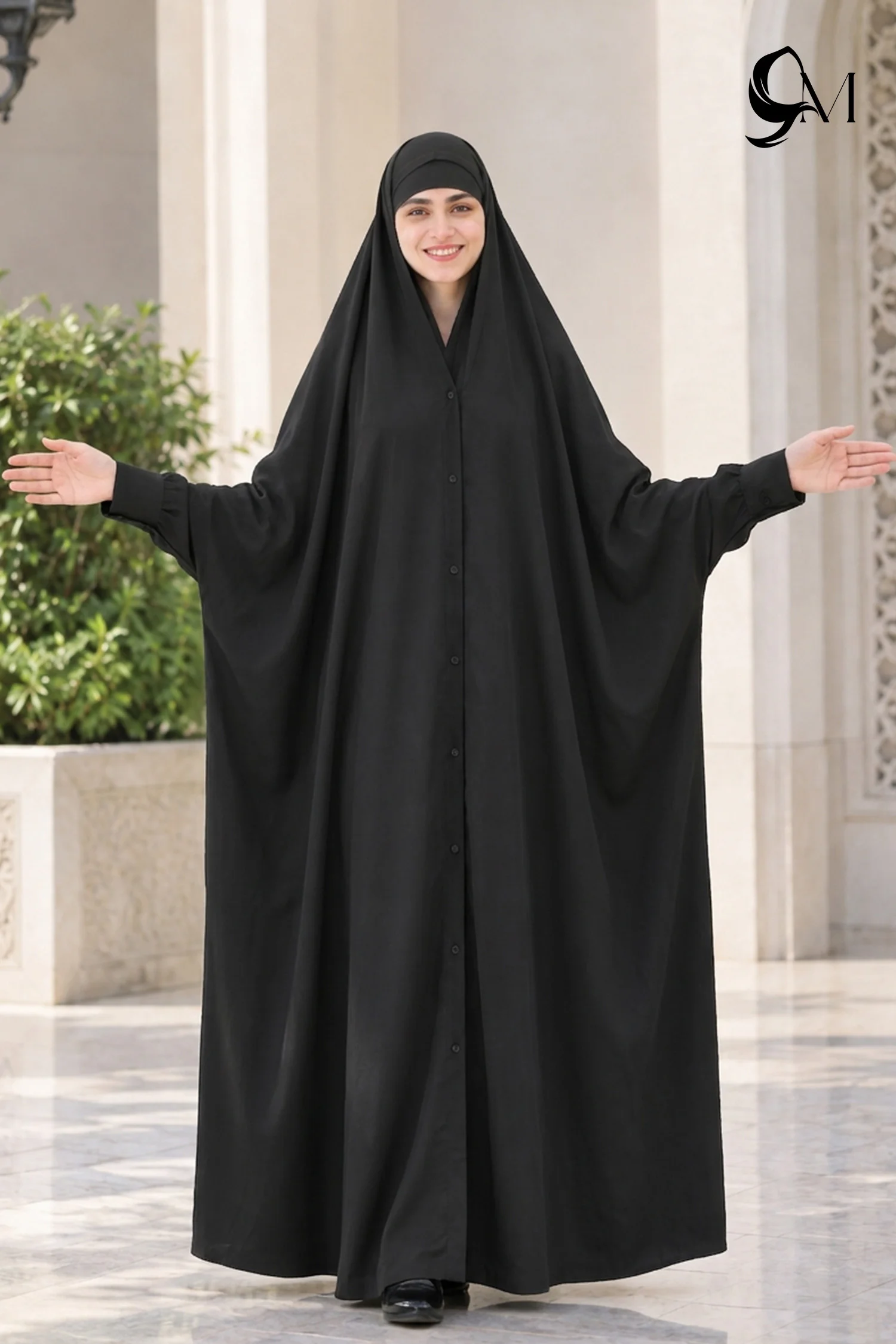
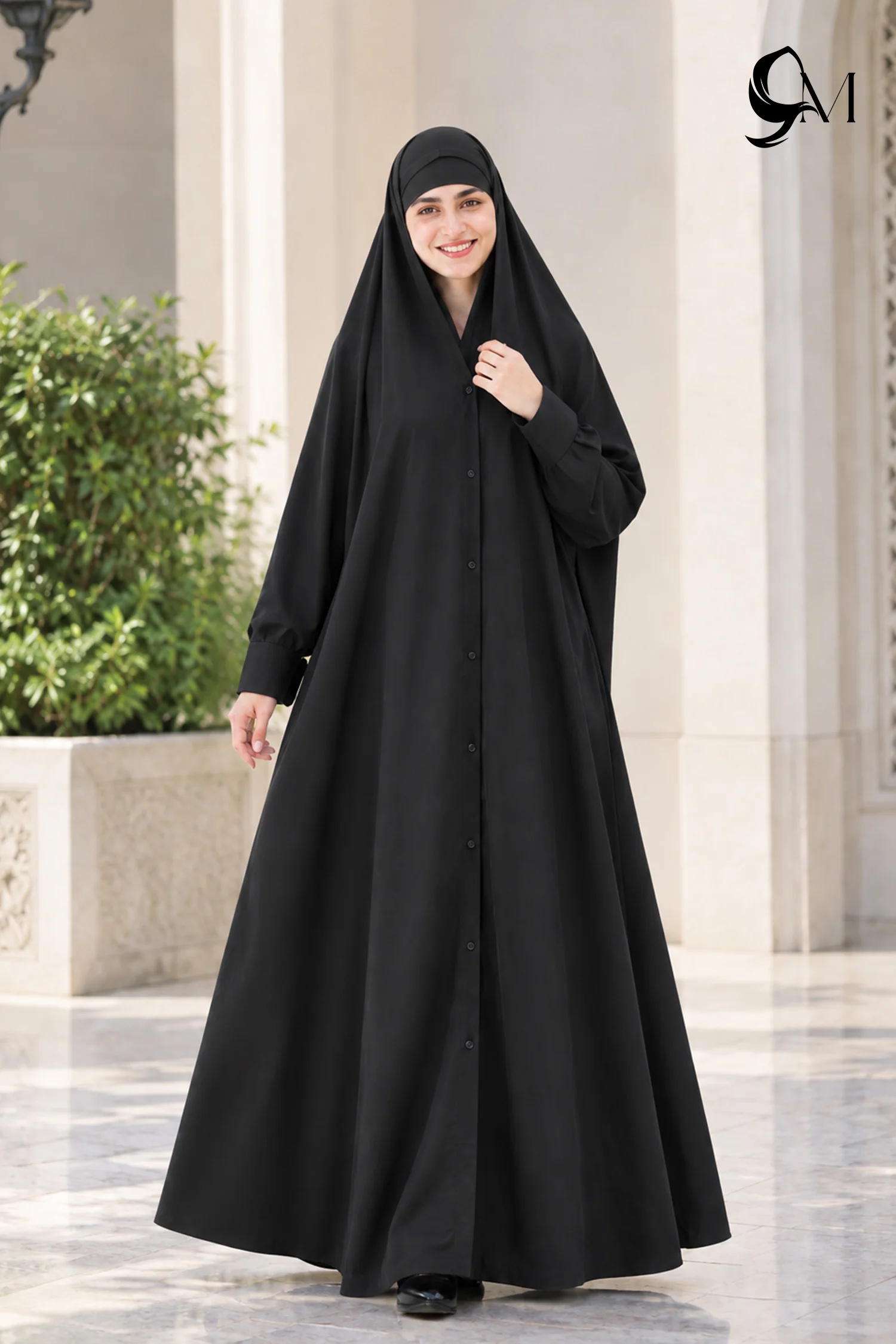
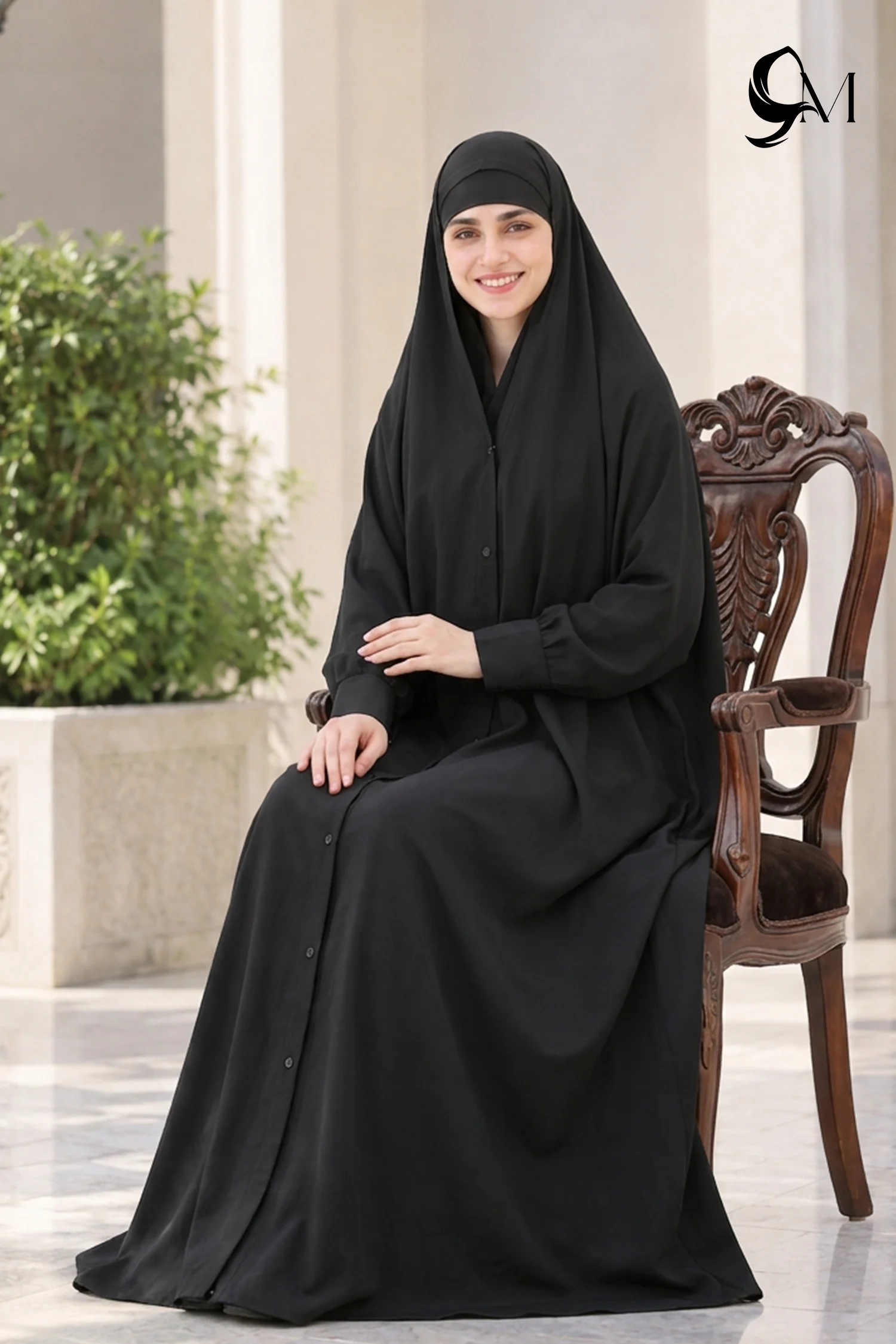
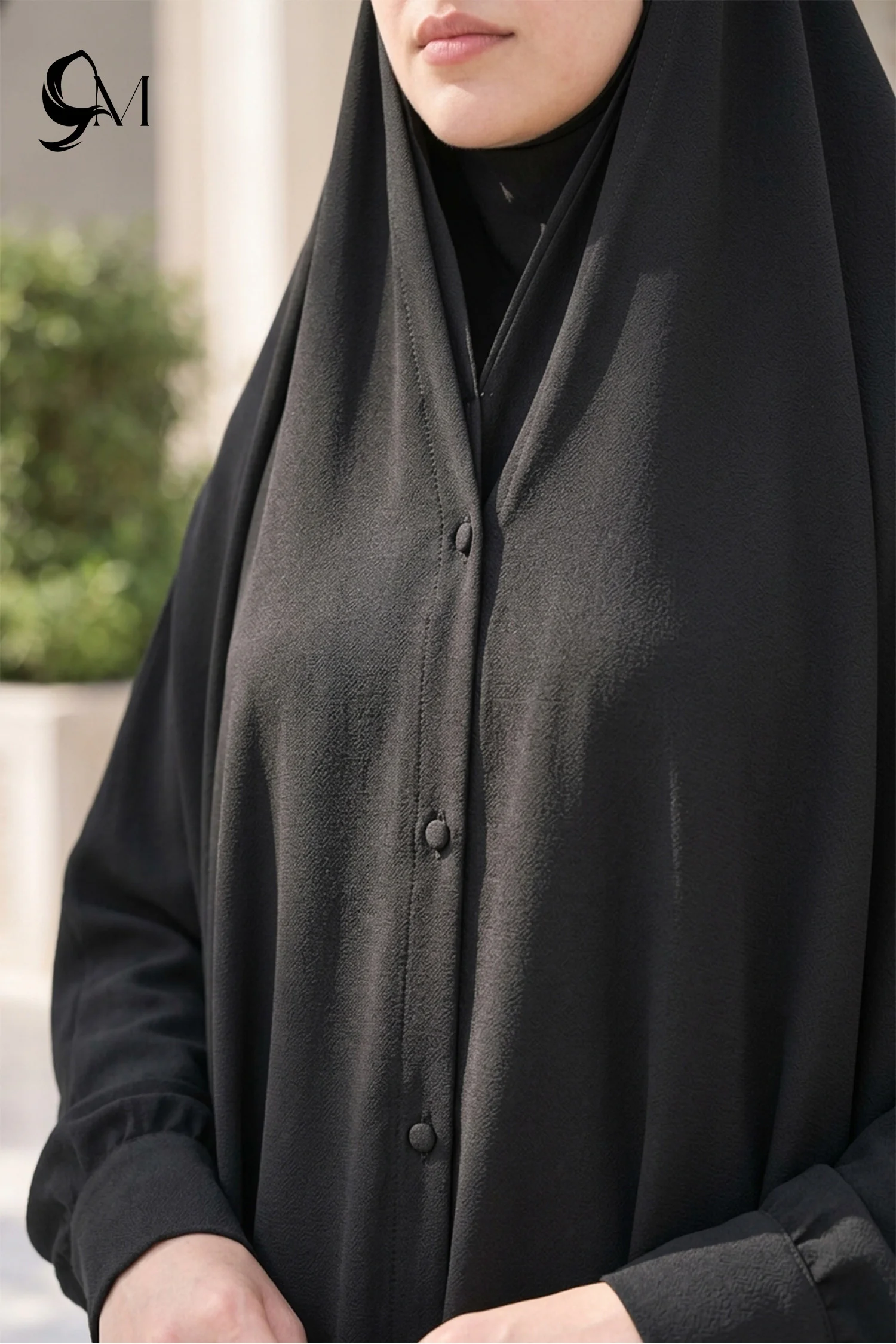
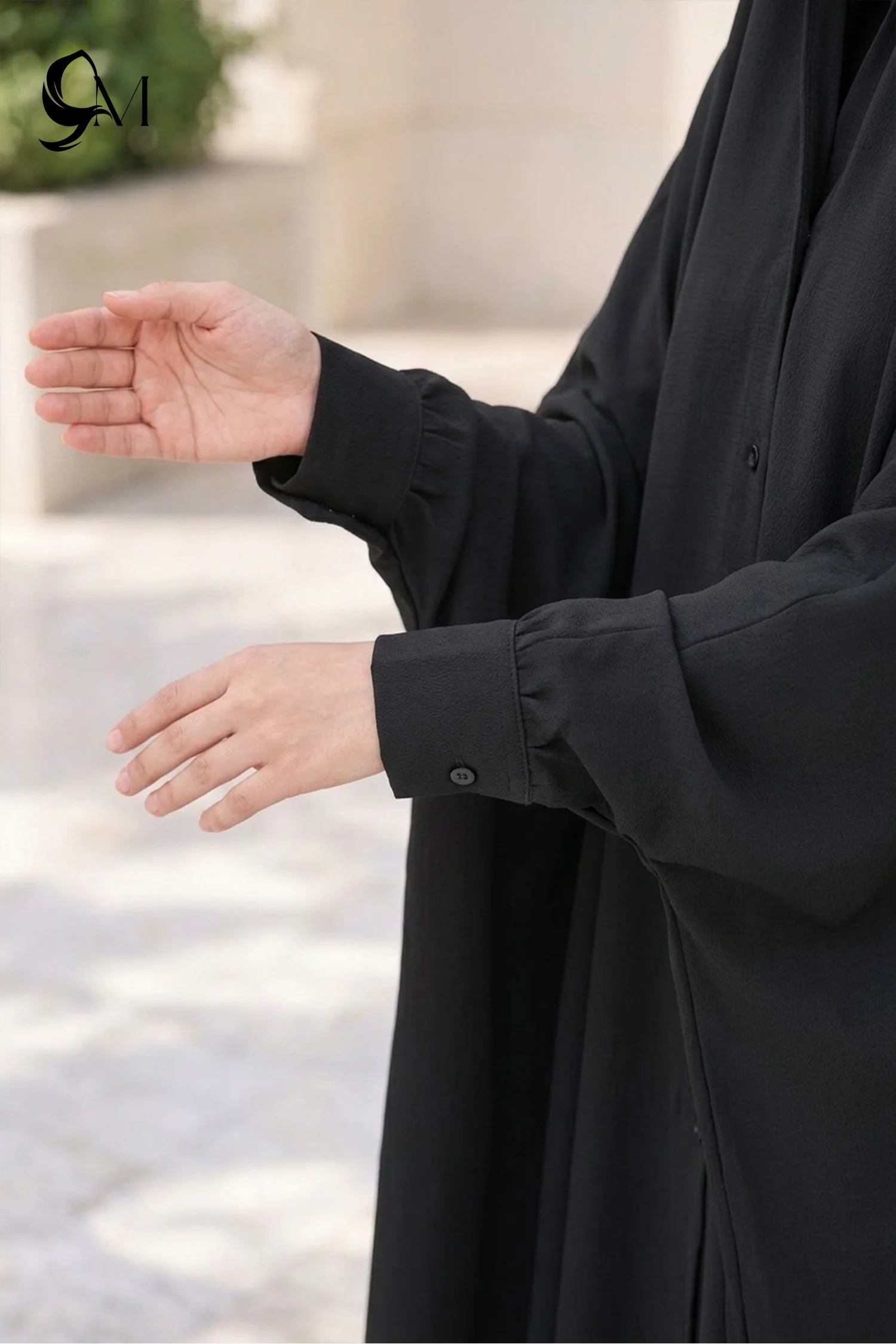
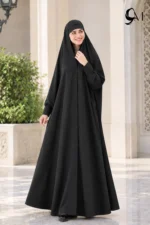
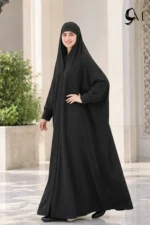
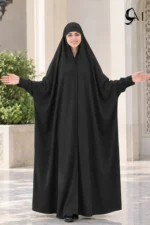
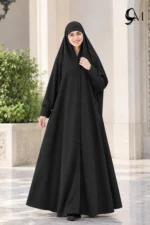
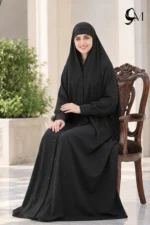
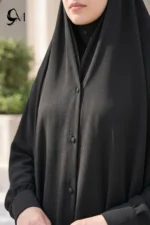
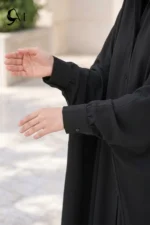


Black Irani Chadar with Sleeves & Buttons | Soft, Breathable and Wrinkle-Free Nida
Pre-Ramzan Sale
Tick-Tock... Tick-Tock!!!
This Discount is Slipping Away… Grab it Today Before It’s Gone Tomorrow!
Coupon Code: Ramzan2025
₨5,200 Original price was: ₨5,200.₨4,699Current price is: ₨4,699.
Payment Methods:
Irani Chadar with Sleeves — Complete Coverage, Both Hands Free
Managing a separate hijab, dupatta, and body covering every time you leave the house or step onto the prayer mat takes more effort than it should. Something slides, something needs pinning, and by the time you are actually ready, you have already adjusted three things twice. An irani chadar solves all of it in one garment, one motion, and under a minute.
Black Irani Chadar in Nida Fabric — Lightweight, Wrinkle-Resistant, and Travel-Ready
This Irani chadar with sleeves is stitched in formal Nida fabric, a soft, breathable, wrinkle-resistant material that drapes cleanly from head to ankle without clinging, creasing in a bag, or requiring ironing every time it comes out of the wash. At 56 inches in length with a 44-inch chest and a round-cut stitching pattern, it falls evenly over the shoulders and stays in place on windy days far better than straight-cut alternatives. The front button closure secures the entire garment without pins, leaves both hands completely free for carrying children, bags, or reading the Quran, and makes it the most practical option for Namaz, mosque visits, and long Umrah days in one breathable layer.
Irani Chadar for Women — For Prayer, Purdah, and Daily Outdoor Wear
Picture arriving at a Masjid al-Haram in Makkah and Medinah and Majlis, Najaf, Karbala, Damascus fully covered and composed, without having adjusted a single pin or readjusted a sliding dupatta since leaving home. This irani chaddar is the traditional covering preferred by Pakistani women observing full purdah, Shia women attending Imambargahs, and increasingly by college and working women who want complete modesty for mosque visits and religious events without changing their entire outfit. The black irani chadar colour is the most widely worn and culturally recognised choice across Pakistan, and the Nida fabric maintains its deep black without fading through repeated gentle machine washes. Standard free size fits chest 44 inches comfortably and is easily alterable for a more tailored fit. Mothers buying this for daughters attending religious classes, women packing for Hajj and Umrah, and those simply wanting one reliable daily outdoor covering consistently choose this irani chadar abaya style for its combination of practicality, modesty, and ease.
Irani Chadar Price in Pakistan
The current price of an Irani chadar is 5200rs. It is important to note that this price may vary based on several external factors, such as changes in manufacturing costs, market demand, and economic conditions. This means that fluctuations in these factors could lead to an increase or decrease in the irani chadar price in Pakistan over time. Buy your irani chadar online from Munawer.Pk today, with Cash on Delivery and fast delivery across Pakistan. Full coverage, zero fuss, from the first time you wear it.
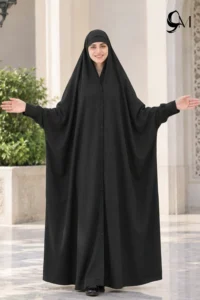
Irani Chaddar: Specifications That Justify the Purchase
Why This Irani Chadar with Sleeves Delivers Complete Coverage for Daily Wear, Hajj and Religious Events
📌 FEATURE BULLETS:
- Full-length 54 inch head-to-ankle single-piece construction → this irani chadar with sleeves and buttons covers head, shoulders, chest, and body completely in one garment, replacing the separate hijab, dupatta, and abaya combination without layering
- Formal Nida fabric construction → soft, lightweight, wrinkle-resistant, and breathable, maintaining a neat pressed appearance even after being folded in a travel bag for Hajj, Umrah, or Ziyarat journeys
- Stitched sleeves with button front closure → both hands remain completely free after buttoning, practical for carrying children, reading Quran, managing luggage, or performing Tawaf in crowded Masjid al-Haram spaces
- Round-cut stitching design → distributes fabric evenly across the shoulders and body for a consistent drape that slips significantly less than straight-cut irani chadar alternatives on windy days or during outdoor movement
- Standard free size at 44 inch chest and 54 inch length → fits most Pakistani women’s heights comfortably with alteration possible for plus-size or petite adjustments without full tailoring
- Classic black colour in Nida fabric → this black irani chadar maintains deep colour across multiple machine washes when washed cold on a gentle cycle with mild detergent, addressing the colour fading complaint common with harsh detergent use on black modest wear
- No pins or additional hijab required for basic wear → an underscarf or hijab cap underneath is sufficient to secure the chadar in place, eliminating the daily pinning routine required with separate hijab and abaya combinations
- Machine washable on cold gentle cycle → practical for daily use without dry-cleaning costs, hang-drying in shade preserves both fabric structure and black colour depth across many wash cycles
- Single garment covers all modesty occasions → this irani chadar abaya functions for daily outdoor wear, Namaz, mosque visits, Imambargah majalis, madrassah attendance, and Hajj or Umrah rituals in one purchase
- Deeply culturally relevant across Pakistani Muslim women’s contexts → strong year-round demand with peak purchasing before Ramadan, Muharram, and Hajj season makes early ordering advisable to avoid stock shortages
Munawer.Pk stocks this irani chadar with sleeves online pakistan listing with actual fabric type, chest measurement, and length confirmed, directly addressing the most consistent Pakistani buyer complaint of premium product photos misrepresenting lower quality fabric delivered by unverified online sellers.
Irani Chadar Questions Pakistani Women Ask Honestly
Q: What is the difference between this Irani chadar and a regular abaya or dupatta?
A: Both are almost the same.
Q: Will the free size fit me properly, or is it made for a specific height range?
A: The standard size with a chest measurement of 44 inches and length of 56 inches fits most Pakistani women of average to slightly above-average height comfortably. At 56 inches length it reaches ankle level on most women between 5’2 and 5’6 in height. For very tall women above 5’7, the hem may fall slightly above the ankle rather than at it. The loose drape design means chest and shoulder width is not a fitting concern for most body types, and the fabric can be easily altered by a local darzi if the length or width needs adjusting.
Q: Is Nida fabric suitable for Karachi’s heat and humidity, or will it feel suffocating?
A: Nida is one of the better fabric choices for Pakistan’s climate precisely because it is lightweight, breathable, and wrinkle-resistant compared to heavier fabrics like jersey or thick georgette. It will feel noticeably cooler than a structured abaya in the same heat. For peak summer outdoor use in very high humidity, no full-length covering will feel completely cool, but Nida manages heat significantly better than most alternatives while still maintaining a neat, presentable drape throughout the day.
Q: Is this chadar suitable for Hajj and Umrah, and will it stay in place during Tawaf?
A: Yes, this is one of the most practical choices for Hajj and Umrah. The sleeves keep your arms covered without needing to manage the fabric, and the button closure keeps the front secure during the physical movement of Tawaf and Sa’i without requiring a hand to hold it. Wearing a light hijab underscarf or hijab cap underneath prevents the head portion from slipping during movement.
Q: Is this specific to Shia women, or is it worn by Sunni women too?
A: The Irani chadar style has strong traditional roots in Shia practice and is the standard covering at Imambargahs and Majalis gatherings. However, it is widely worn by Sunni women across Pakistan as well, particularly for Namaz, mosque visits, Umrah, religious events, and daily outdoor coverage. The garment itself carries no sectarian restriction. Any Muslim woman who wants full head-to-ankle coverage in a single, practical piece will find it equally suitable regardless of madhab.
Q: What is an Irani chadar with buttons and how is it more convenient to wear?
A: An Irani chadar with buttons features a row of buttons — typically 3 to 5 buttons — along the center front from the neckline downward, providing a closure alternative to both the traditional pin method and the zipper:
Convenience advantages of button closure:
Easy wearing and removal:
Buttons are intuitive and quick to use — the chadar can be put on and removed rapidly, which is particularly convenient for women who move between environments requiring different dress codes throughout the day
Adjustable front opening:
Individual buttons can be left open for deliberate ventilation or movement accommodation — particularly useful in Pakistan’s summer when full closure can be very warm; the wearer can unbutton from the bottom while keeping the upper buttons closed for modesty
No mechanical failure risk:
Unlike zippers which can jam, split, or break, buttons rarely fail and can be easily replaced if one is lost — extending the chadar’s usable life with simple maintenance
Cultural familiarity:
Button closures are deeply familiar in Pakistani garment culture — women accustomed to Pakistani clothing find button closures intuitive; zippers on modest outer garments are a newer convention
Aesthetic integration:
Buttons can be decorative as well as functional — pearl buttons, fabric-covered buttons, or embellished buttons on a fancy Irani chadar add an aesthetic element that zippers cannot
Q: What are the benefits of an Irani chadar with both sleeves and buttons?
A: The combination of sleeves and button closure represents the most practically complete everyday Irani chadar design — combining the coverage advantages of sleeves with the convenience and security of a closure mechanism:
Combined benefits:
- Complete coverage without auxiliary clothing requirements — sleeves handle the arms; the button closure handles the front; the full-circle or semicircular cut handles the body and head; no aspect of coverage relies on underlying clothing choices
- Fully hands-free operation — once worn and buttoned, nothing needs to be held or managed; complete freedom of movement with reliable coverage
- Appropriate for all activities — shopping, carrying children, cooking at outdoor events, attending ceremonies, using public transport — all activities are manageable without compromising coverage
- Most weather-resistant — sleeves and button closure together resist wind displacement of the covering most effectively
- Best for active outdoor use — the combination is the most practical for Pakistani women who are active outside the home
Most suitable use contexts: Daily public outdoor wear in urban Pakistani environments, religious occasions, visits to religious sites, outdoor bazaar shopping, and any situation requiring confident, maintained modest covering without constant management.
Q: The fabric looks very rich in product photos online. How do I know what I am actually receiving?
A: Mismatched product photos are the most common complaint across this category on Pakistani online platforms. The specific details to verify when your order arrives are fabric weight and texture. Genuine formal Nida has a smooth, slightly structured feel that holds its drape rather than collapsing limply. At Munawer.Pk, you can open and inspect your order before paying on COD, so check the fabric quality, stitching at the button placket, and sleeve attachment before handing over payment. If the fabric feels thin, roughly stitched at the seams, or significantly lighter than expected, then don’t accept your order.
Q: How do I wash this without fading the black colour?
A: Machine wash on a cold gentle cycle or hand wash with a mild detergent, and hang to dry in shade rather than direct sunlight, since sunlight fades black fabric faster than almost anything else. Avoid harsh detergents or bleach-based products entirely on black Nida. If ironing is needed, use low heat or iron the chadar inside out to protect the fabric surface. Do not tumble dry since heat shrinks the fabric and weakens the button stitching over time. Washing it separately from other garments on the first wash prevents any colour transfer from the black dye.
Q: What is an Irani chadar and how is it different from a regular chadar or dupatta?
A: An Irani chadar is a large, semi-circular or full-circular piece of fabric designed to cover a woman from the top of the head to the feet in a single flowing garment, originating from the Iranian tradition of the chador — the full-body covering widely worn by women in Iran. Unlike a regular Pakistani chadar, which is typically a rectangular piece of fabric used as a shawl or wrap over the shoulders and head without necessarily providing full-body coverage, the Irani chadar is specifically designed to envelop the entire body from head to floor in one continuous drape.
Q: What type of Irani chadar is most suitable and modest for women in Pakistan?
A: The most suitable and comprehensively modest Irani chadar for Pakistani women combines several features that ensure complete coverage with practical wearability:
Most modest and practical options:
Irani chadar with sleeves:
The most complete coverage option — stitched sleeves ensure the arms remain covered in all positions including when reaching, carrying items, or moving in ways that might cause a sleeveless draping to expose the arms
Irani chadar with built-in headpiece:
A design that integrates a fitted head covering — similar to a makhna — ensuring the head, hair, and neck remain covered without requiring a separate hijab or headpiece underneath
Full-circle cut:
A full-circle (360-degree) cut provides more fabric fullness and therefore more reliable coverage in all positions compared to a semicircular cut; the extra fullness means bending, sitting, and moving don’t create gaps in coverage
Opaque, heavy-enough fabric:
An adequately opaque fabric that doesn’t become transparent in bright light or when stretched — particularly important for outdoor use in Pakistan’s intense sunshine where thin fabrics become see-through
For Pakistani context specifically: Black Irani chadars in a medium-weight polyester or nida fabric with sleeves and a secure closure (zip, button, or velcro) represent the most widely adopted comprehensively modest choice among Pakistani women who wear the Irani chadar style.
Q: What is an Irani chadar with sleeves and what are its advantages over one without sleeves?
A: An Irani chadar with sleeves has stitched, full-length sleeves incorporated into the garment’s construction — typically attached at the shoulder seams of the fabric — transforming the draped covering into a more structured, garment-like outer covering:
Advantages over sleeveless:
Reliable arm coverage:
The most significant practical advantage — sleeves maintain arm coverage regardless of body movement, activities, or how the draping fabric may shift; without sleeves, any arm movement risks exposing the arms as the fabric falls away
No need for additional arm coverage:
With a sleeved chadar, the underlying clothing doesn’t need to have full-length sleeves — the chadar itself provides this coverage; sleeveless chadars require fully-sleeved underlying clothing to maintain overall modesty
Better suited for outdoor activities:
Walking, carrying bags, managing children, shopping — all activities that involve arm movement are better managed when arm coverage is reliably secured by stitched sleeves rather than relying on draping fabric
More secure in wind:
Pakistan’s variable weather — particularly monsoon wind and the strong seasonal winds of Islamabad and Peshawar — can dramatically shift draped fabric; sleeves anchor the chadar to the body more securely
Easier single-handed management:
Without needing to constantly manage the draping fabric over the arms, the wearer has more freedom for daily activities while maintaining complete coverage
Q: Is an Irani chadar without sleeves still considered a modest and complete covering?
A: Yes — an Irani chadar without sleeves is fully acceptable as a modest outer covering when worn correctly over appropriate underlying clothing. The Islamic modesty requirement is that the awrah (the body parts requiring covering in public) is covered — the chadar as a garment achieves this through its fabric coverage rather than requiring a specific construction method. The key conditions for a sleeveless Irani chadar to provide complete modesty:
Adequate underlying clothing:
The woman’s underlying clothing must have full-length sleeves since the chadar’s draping fabric doesn’t reliably cover the arms in all positions; a long-sleeved abaya, long-sleeved kurta, or similar under-layer makes the sleeveless chadar fully appropriate
Secure head and neck coverage:
The chadar must be held or arranged to maintain consistent head and neck coverage — typically by holding the front edges together under the chin or using a pin or brooch to secure it
Sufficient fabric fullness:
A large enough semicircle (at least 180 degrees, ideally full 360-degree circle) to wrap around and cover the front of the body
For everyday Pakistani use: The sleeveless style is popular precisely because it is lighter, cooler, and easier to manage in warm weather — making it the more practical choice for Pakistan’s climate for women who wear adequately covering clothing underneath.
Q: What is an Irani chadar with a zip and how does it provide a more secure fit?
A: An Irani chadar with a zip incorporates a concealed or visible zipper running from the neckline down the center front of the chadar — typically from just below the chin to approximately waist or mid-chest level. This design feature solves the primary practical challenge of the traditional sleeveless Irani chadar, which requires the wearer to hold the front edges together under the chin or use a pin to maintain closure:
Security advantages of the zip closure:
Completely hands-free wearing:
Once zipped, the chadar stays closed without any manual holding or pinning — freeing both hands for daily activities; a significant practical improvement for mothers managing children, women carrying shopping, and anyone engaged in active outdoor tasks
Consistent front coverage:
The zip prevents the front edges from separating accidentally — which happens easily with a draped chadar when the arms are moved or when wind catches the fabric
No pin requirement:
Pins can open accidentally, cause injury, and require careful placement to maintain modesty; a zip eliminates this concern entirely
Neater appearance:
A zipped closure creates a smooth, clean front line rather than the gathered appearance that can result from holding or pinning
Adjustment flexibility:
The zip can be partially opened from the bottom for easier movement while keeping the top (chest and head area) securely closed — a practical option when sitting or using stairs
Q: What is an Irani rida chadar and how is it different from a standard Irani chadar?
A: A rida is a specific two-piece modest outer garment primarily associated with the Dawoodi Bohra community — a Shia Muslim community with significant populations in Karachi, other Pakistani cities, and across the Indian subcontinent. The Irani rida chadar combines elements of the rida style with the Irani chadar tradition:
What a rida is:
A rida consists of two parts — a fitted upper piece (rida ki angi or choli) that covers the upper body and a lower piece (rida ki taan or skirt) — worn together as a complete modest outer covering with specific styling associated with Bohra cultural and religious identity
How an Irani rida chadar differs from standard Irani chadar:
- The rida style typically incorporates decorative elements — embroidery, brocade borders, and distinctive styling — that reflect the Bohra community’s aesthetic traditions; standard Irani chadars tend toward minimalism
- The rida is a culturally specific garment with community identity significance beyond its function as a modesty covering
- Rida chadars are more often in two-piece construction; standard Irani chadars are single-piece
- The rida has specific cultural conventions around color and occasion that differ from the broader Pakistani Irani chadar tradition
In Pakistani context: Irani rida chadars are primarily relevant for the Bohra Muslim community concentrated in Karachi; for the broader Pakistani Muslim population, the standard single-piece Irani chadar is the more common reference.
Q: What is the difference between an Irani chadar and a regular dupatta in terms of coverage?
A: (Already answered above — please refer to “What is an Irani chadar and how is it different from a regular chadar or dupatta?” The key distinctions are size, cut, coverage completeness, and intended function — the Irani chadar is a complete outer covering garment; a dupatta is a decorative modesty accessory.)
Q: Is an Irani chadar suitable for offering namaz and does it provide full coverage during prayer?
A: A properly designed and sized Irani chadar is an excellent choice for prayer — in many ways more suitable than a standard namaz chadar because its design already addresses full-body coverage:
Why it works well for namaz:
- The full-circle or large semicircular cut provides abundant fabric that maintains coverage in all prayer positions — qiyam (standing), ruku (bowing), and sujood (prostration)
- A sleeved Irani chadar provides complete arm coverage through all positions including the raised-arms takbeer position
- The flowing fullness means the back doesn’t become exposed during sujood — a common coverage issue with poorly designed or undersized prayer coverings
What to verify for namaz use:
- Ensure the fabric is completely opaque — thin or semi-transparent fabrics don’t fulfill the coverage requirement even when the body is technically covered
- Confirm the head covering is secure and won’t slip during the movements of prayer; a zip or button closure at the front helps maintain consistent head position
- The chadar must cover to the ankles at minimum in all prayer positions — check this specifically in the sujood position where the garment’s back length is most tested
Q: What makes an Irani namaz chadar different from a regular namaz chadar?
A: The Irani namaz chadar combines the traditional Irani chadar’s full-body draping design with specific features optimized for prayer use:
Design differences:
Irani namaz chadar:
- Normally available in black and no pattern (Simple)
- Based on the semicircular or full-circle Irani chadar cut
- May include a built-in makhna-style head piece for more secure head coverage during prayer movements
- Often includes a zip or button closure to maintain front coverage hands-free during prayer
- Specifically sized and cut to ensure coverage in all prayer positions — particularly sujood where coverage requirements are most demanding
- May be lighter weight than an everyday Irani chadar since it’s primarily for indoor prayer use rather than outdoor weather protection
Regular namaz chadar (Pakistani style):
- Available in printed lawn
- Often rectangular cut with a separate attached head covering
- More familiar to Pakistani women accustomed to traditional namaz chadar formats
- May include a makhna or fitted head piece in a two-piece set construction
- Available in a wider range of fabrics including heavier embroidered versions for prayer aesthetic
Nutshell: Both fulfill the same religious coverage requirement for salah.
Q: What type of Irani chadar is most suitable for a bride on her wedding day?
A: Bridal Irani chadars represent a significant and growing niche in Pakistani wedding fashion — particularly for nikah ceremonies where modesty is emphasized alongside celebratory elegance:
Most popular bridal Irani chadar styles:
Embroidered luxury Irani chadar:
- Heavy embroidery in gold, silver, or thread work on ivory, white, or cream base fabric
- Often in velvet, silk, or premium chiffon with gota, dabka, or zardozi embroidery
- The embroidery concentrated on the border and edges creates a framing effect that is elegant in photographs
Color-coordinated bridal chadar:
- Matching or complementary to the bridal dress color — if the bride wears a maroon lehenga, the Irani chadar might be maroon with gold embroidery
- Creates a cohesive, deliberately styled bridal look rather than a standard black everyday chadar
Embellished net or chiffon:
- Sheer or semi-sheer luxury fabrics with heavy embellishment; worn over a fully opaque undercovering
- Provides the visual beauty of fine fabric with modesty through layering
What makes a bridal Irani chadar special:
- The scale and quality of embellishment significantly exceeds everyday chadars
- Special fabrics — silk, premium chiffon, high-quality velvet — rather than the polyester of everyday chadars
- Often custom-made or tailored to coordinate specifically with the bridal outfit
- In Karachi and Lahore, specialty Islamic fashion boutiques create bespoke bridal Irani chadars
Q: What are the most popular bridal Irani chadar styles for nikah and wedding ceremonies?
A: (Already answered above — embroidered luxury styles, color-coordinated options, and embellished net/chiffon are the primary bridal styles.)
Q: What is an Irani nikah chadar and how is it traditionally worn during a nikah ceremony?
A: An Irani nikah chadar is a specifically bridal, ceremonially significant version of the Irani chadar worn by the bride during her nikah (Islamic marriage contract ceremony):
Cultural significance:
In Pakistani Islamic tradition, the nikah ceremony is the most religiously significant moment of the wedding — the bride’s appearance at this ceremony typically reflects the highest level of modest dress; the Irani nikah chadar fulfills both the religious modesty requirement and the ceremonial beauty expectation simultaneously
Traditional wearing during nikah:
- The chadar is placed over the bride’s head and arranged to drape over her fully — typically with both the front edges held or pinned to keep the face visible while maintaining coverage
- In some Pakistani traditions, the chadar is placed on the bride’s head by a respected elder female family member as a gesture of blessing and transition into married life
- During the nikah itself, the bride remains covered throughout the proceedings
- The chadar may be held in place by family members during photography to maintain the arranged draping
Design for nikah use:
- Generally more heavily embellished than everyday Irani chadars
- White, ivory, cream, or in the bride’s wedding color family
- Large enough to cover the full bridal outfit — often a longer and wider cut than everyday chadars to accommodate the volume of bridal clothing underneath
Q: What is the difference between an Irani chadar and a burqa in terms of coverage and style?
A: Both the Irani chadar and the burqa provide full-body covering for women but differ significantly in construction, aesthetic, and regional association:
Irani chadar:
- A single piece of fabric (semicircular or circular) draped over the head and body
- No stitched body structure — the coverage comes from the draping of the fabric
- Face is typically uncovered (though the wearer may choose to add a niqab)
- More fluid and flowing in appearance; the fabric moves naturally
- Associated with Iranian/Persian cultural tradition
- Holding or pinning the front is the traditional closure method (though modern versions have zips/buttons)
- Reveals the general body shape through the draping
Afghan/Pakistani-style burqa (shuttlecock burqa):
- A fully stitched garment with a structured body covering from head to floor
- Includes an embroidered mesh screen covering the eyes — the face and eyes are covered by this mesh panel
- No choice about face coverage — face covering is integral to the design
- More structured appearance; the pleated skirt creates volume
- Associated with Afghan Pashtun culture; widely worn in KPK and Afghan refugee communities in Pakistan
- Put on over the head like a structured garment
Arabic-style niqab and abaya:
- The abaya is a stitched open-front robe; the niqab is a separate face veil
- Each component is separate and distinct
- More structured garment construction
Coverage comparison:
The Afghan burqa is the most complete coverage including the eyes behind a mesh screen; the Irani chadar leaves the face uncovered unless a separate niqab is added; the abaya with niqab also leaves the eyes visible
Q: What is an Irani chadar abaya and how does it combine features of both?
A: An Irani chadar abaya is a hybrid garment that combines the flowing, head-to-floor coverage philosophy of the Irani chadar with the structured, stitched garment construction of an abaya:
Construction characteristics:
- Fully stitched — unlike the traditional draped Irani chadar, the chadar abaya has a constructed body with defined structure
- Head covering integrated — either an attached hood, a makhna-style headpiece, or an integrated scarf panel that provides automatic head coverage when worn
- Open-front design like a traditional abaya — worn by putting over the head or slipping on with front closure
- Full-length to the floor — maintains the Irani chadar’s complete floor-length coverage
- May include sleeves — making it a complete covering garment requiring no additional clothing for coverage
How it differs from a standard abaya:
- The integration of head covering distinguishes it from a standard abaya which requires a separate hijab
- The flowing, less tailored silhouette is more reminiscent of the Irani chadar’s draping aesthetic than the fitted or semi-fitted Arabic abaya silhouette
Who wears it:
- Pakistani women who want the comprehensive coverage of an Irani chadar with the structural convenience of a stitched garment
- Women who find the traditional draped Irani chadar difficult to manage but want equivalent coverage
Q: What is an Irani chadar with niqab and is face covering required when wearing one?
A: An Irani chadar with niqab is a combined set consisting of the standard Irani chadar plus a matching niqab (face veil) — either attached or as a coordinated separate piece:
The niqab component:
- A face covering that covers from below the eyes (or including the eyes in the full niqab style) to the chin and sides of the face
- Attached niqab versions are sewn directly onto the chadar at the forehead area and can be flipped up when not needed
- Separate matching niqab versions come as a coordinated set
Is face covering required?
This is a question of Islamic scholarly opinion rather than unanimous ruling:
The majority scholarly position (Hanafi, Maliki, Shafi’i): Covering the face is not obligatory (wajib) for Muslim women; it is considered a recommended act of additional modesty (mustahabb) that carries spiritual merit but is not a condition of valid modesty compliance
Minority scholarly position (some Hanbali scholars): Face covering is obligatory; the niqab is part of the required modesty covering
Pakistani scholarly consensus: The predominant Pakistani Islamic scholarly position follows the majority view — face covering is not obligatory but is virtuous; wearing an Irani chadar without the niqab is fully appropriate
For women who wear niqab: Having a chadar with an integrated or matching niqab provides a complete, coordinated modest covering set; the niqab reflects personal religious practice and commitment rather than being a universal requirement
Q: How does an Irani chadar work as a hijab and does it provide complete head and body coverage?
A: The Irani chadar functions as a comprehensive hijab (modest covering) by covering both the head and the body simultaneously in a single garment — making it one of the most complete single-piece hijab solutions available:
Head coverage:
The top of the Irani chadar is placed at the hairline or slightly forward on the head; the fabric drapes over and around the head covering hair, ears, and neck completely; when held or pinned at the front, it maintains this head coverage
Body coverage:
The semicircular or circular cut creates enough fabric fullness to cover the shoulders, arms (in sleeved versions), chest, back, and front completely down to the floor
How it compares to other hijab styles:
- Versus a separate hijab + abaya combination: The Irani chadar provides equivalent coverage in a single garment rather than requiring separate headscarf and body covering — simpler but requiring more management of the draping
- Versus a khimar (cape-style hijab): The khimar covers the head and upper body but not the lower body; the Irani chadar extends floor-length
Coverage in the Islamic sense:
The Irani chadar, when properly worn, covers all of the awrah (the body parts requiring covering in public for women) according to the majority scholarly interpretation — making it a complete Islamic modest covering in one garment
Q: What is a Shia-style Irani chadar abaya and how is it traditionally worn?
A: The Shia-style Irani chadar abaya is closely associated with the modest dress tradition of Shia Muslim women — particularly those influenced by Iranian Islamic dress conventions following the 1979 Islamic Revolution in Iran:
Traditional characteristics:
- Typically black — the standard color in Iranian Shia tradition; reflects simplicity and uniformity of modest dress
- Full-circle or large semicircular cut providing maximum coverage
- Often in a flowing, lightweight fabric (typically polyester crepe or similar) that drapes elegantly without excessive weight
- Face uncovered as is standard in Iranian practice (niqab is not traditionally part of Iranian Shia dress culture)
- The edges may be held at the front or the woman may hold the chadar in place using her hands or teeth in the traditional manner — without a closure mechanism in the most traditional form
Traditional wearing method:
- Place the center of the top edge at the hairline
- Allow the fabric to flow over the head and around the body
- Hold the front edges together under the chin or at chest level
- The hands may hold the edges together, freeing them only when using both hands is necessary — at which point the teeth traditionally hold the edges in place momentarily
In Pakistani context:
Worn by Shia Muslim women in Pakistan — concentrated in Karachi, the southern Punjab, and communities in major cities — particularly for religious occasions, visiting shrines, attending majalis, and formal religious functions during Muharram and other significant Shia religious observances.
Q: What is the difference between an Iraqi abaya and an Irani chadar abaya?
A: Both are full-body modest covering garments but reflect distinct cultural and aesthetic traditions:
Iraqi abaya:
- Traditionally a long, flowing black cloak worn open-front with a matching headscarf
- Made from a specifically lightweight, shiny fabric — typically a smooth polyester with a slight sheen distinctive to the Iraqi abaya tradition
- The fabric has a characteristic drape and movement that is lighter and more fluid than typical abaya fabrics
- Often with decorative elements at the cuffs and edges in the more elaborate versions
- Worn with a matching black headscarf that frames the face
- Associated with Iraqi and Levantine cultural modesty traditions
- The front is open and held together at the chest; no closure mechanism in the traditional form
Irani chadar abaya:
- Based on the Irani chador tradition — full-circle or semicircular cut providing all-around coverage
- Typically a matte, less shiny fabric — polyester crepe or similar with more body than the Iraqi abaya fabric
- Worn by placing over the head with the coverage falling all around the body
- May have closure mechanisms (zip, button) not typical in Iraqi abayas
- More enveloping in coverage than the open-front Iraqi abaya style
- Associated with Iranian cultural and religious tradition
Key visual distinction: The Iraqi abaya has a more open, flowing, cloak-like appearance with defined front panels; the Irani chadar creates a more enveloping, tent-like silhouette.
Q: What makes an Irani chadar fancy and for what occasions is it most suitable?
A: A fancy Irani chadar elevates the basic coverage garment into an occasion-appropriate piece through specific design elements:
Elements that make an Irani chadar fancy:
Embroidery:
- Gota, dabka, zardozi, or thread embroidery concentrated at borders, edges, and the central chest area
- Hand embroidery versus machine embroidery — hand work commands higher prices and is considered more prestigious
Premium fabric:
- Velvet (for winter formal occasions), silk chiffon, georgette, or premium crepe rather than standard polyester
- The fabric’s quality is immediately visible in its drape and movement
Stone and sequin work:
- Scattered or densely applied crystal stones, sequins, or mirror work on the fabric surface
- Creates light-catching shimmer appropriate for evening and formal occasions
Lace borders:
- Delicate lace finishing at the hem and edges adds elegance without heavy embroidery
Color:
- Moving beyond everyday black to deep jewel tones (navy, burgundy, emerald) or soft neutrals (grey, ivory) for specific occasions
Most suitable occasions for fancy Irani chadars:
- Nikah and wedding ceremonies — particularly as the bride’s or close family member’s covering
- Eid celebrations — embellished chadars for Eid prayers and family gatherings
- Formal religious occasions — maulids, religious anniversaries
- Formal social events where both modesty and occasion-appropriate appearance matter
Q: What are the most popular printed designs available in Irani chadars?
A: While traditional Irani chadars are predominantly solid black, the Pakistani market has developed a wider range of printed designs that reflect local aesthetic preferences:
Popular print categories:
Floral prints:
- Small, all-over floral patterns on dark grounds — navy, dark green, or black base with subtle floral designs
- Particularly popular among younger Pakistani women who want modest coverage with visual interest
Geometric patterns:
- Symmetrical geometric designs reflecting Islamic geometric art tradition
- Available in tone-on-tone (dark print on dark ground) or with color contrast
Paisley/boteh designs:
- Traditional South Asian motif applied to chadar fabric
- Often in border format rather than all-over print
Embossed/self-print (tonal):
- The same color throughout but with a woven or printed pattern that creates texture visible in light
- More subtle than contrasting color prints; maintains the modest visual simplicity of the Irani chadar tradition
Calligraphy prints:
- Arabic or Quranic calligraphy printed on the fabric — increasingly popular for religiously motivated wearers
- Worn with awareness that Quranic text on clothing requires respectful handling
Abstract prints:
- Contemporary abstract designs popular in the younger Pakistani modest fashion market
Q: What is the correct and modest way to wear an Irani chadar?
A: The correct wearing method for an Irani chadar balances Islamic modesty requirements with the practical management of a large draped garment:
Step-by-step wearing method:
- Head placement: Hold the chadar at the center of its top edge and place this center point at the hairline — this ensures equal fabric distribution on both sides of the head and body
- Head coverage: Allow the fabric to fall over the head, covering hair, ears, and neck completely; the fabric should come forward enough to frame the face without exposing any hair at the front
- Front closure: Bring the two front edges together under the chin or at the mid-chest level; the traditional method is holding them together in one hand; modern method is using the built-in zip, button, or pin
- Body draping: Allow the fabric to fall naturally over the shoulders and body; a full-circle cut distributes the fabric evenly around the body providing complete coverage
- Length check: Confirm the chadar reaches the floor or ankle level at the front, sides, and back; lift the arms and confirm coverage is maintained
- Movement check: Perform a brief movement check — reach forward, bend slightly, check that no gaps appear at the head, front, sides, or back
For ongoing coverage management:
In a traditional sleeveless chadar, one hand typically holds the front edges together throughout use; this is why sleeved or closure-equipped chadars are more practical for active use.
Q: How do you wear an Irani chadar without sleeves while maintaining full coverage?
A: (Already answered — wear over fully-sleeved underlying clothing; hold or pin the front edges securely; choose a full-circle cut for maximum coverage. Refer to “Is an Irani chadar without sleeves still considered modest?” above for complete guidance.)
Q: How do you style an Irani chadar with a hijab for a complete and modest look?
A: While the Irani chadar itself covers the head, many women wear a hijab or al-amira (inner cap) underneath for a more polished and layered look:
The practical combination:
Inner cap/bonnet underneath:
A fitted inner cap (typically a jersey or cotton under-scarf) worn directly on the head before the Irani chadar; this prevents the chadar fabric from sliding off the hair surface and maintains the chadar in position more reliably than placing it directly on hair
Al-amira hijab underneath:
A two-piece hijab (cap plus tube scarf) worn as an inner layer; provides secure head coverage that keeps the Irani chadar positioned correctly even during movement
Color coordination:
If the inner hijab is visible at the face frame, matching it to the chadar color (both black, for example) creates a seamless, unified look; a contrasting inner hijab creates a deliberate layered effect that some women choose as a style statement
For sleeved chadar with hijab:
The inner hijab provides a clean face-framing layer; the sleeved chadar then goes over the top providing complete outer coverage; the combination is extremely neat in appearance
Q: What is the standard cutting pattern used for making an Irani chadar?
A: The Irani chadar’s distinctive coverage is achieved through its specific geometric cutting pattern — fundamentally different from a rectangular piece of fabric:
Semicircular cut (most common):
- A large semicircle with a radius of approximately 130 to 150cm (depending on the wearer’s height)
- The straight edge of the semicircle forms the top (head area) of the chadar
- A small head-opening semi-circle or straight cut at the center of the straight edge accommodates the head
- Total fabric required: approximately 2.5 to 3 meters of 150cm-wide fabric
Full-circle cut (maximum coverage):
- A complete circle with radius of approximately 100 to 120cm
- A central opening (approximately 22 to 25cm diameter) for the head
- Provides the most even fabric distribution all around the body
- Total fabric required: approximately 3 to 4 meters of 150cm-wide fabric depending on circle diameter
Head opening:
- The head opening is typically a small forward-positioned circle (not central — positioned slightly toward the front of the pattern) to ensure more fabric falls at the front and back than at the sides
- Finished with a hem, facing, or elastic casing
Border finishing:
- The curved outer edge (the hem of the chadar) is typically finished with a rolled hem, lace border, or embroidered trim
Q: What are the correct cutting and stitching measurements for an Irani chadar?
A: Standard measurements used by Pakistani tailors for Irani chadars across different heights:
For average height (160 to 165cm):
Semicircular design:
- Radius: 135cm
- Head opening at top center: 11cm radius semicircle (22cm across)
- Total diameter of the full semicircle: 270cm
- Fabric needed: 2.75 to 3 meters of 150cm-wide fabric
Full-circle design:
- Radius: 115cm (providing floor-length coverage at average height)
- Head opening: 11 to 12cm radius circle (22 to 24cm diameter)
- Positioned 3 to 4cm forward of true center to provide more front/back coverage than side coverage
- Fabric needed: 3.5 to 4 meters of 150cm-wide fabric (two fabric widths joined for the full circle)
Height adjustments:
- For heights above 165cm: increase radius by 5 to 7cm per 5cm of additional height
- For heights below 160cm: decrease radius by 3 to 5cm per 5cm of reduced height
Sleeve dimensions (if adding sleeves):
- Sleeve length: 60 to 62cm
- Sleeve width at armhole: 40 to 42cm
- Tapered to 28 to 32cm at the cuff
- Attached at shoulder level on the chadar’s fabric
Q: How is an Irani chadar with sleeves cut and stitched for proper fit?
A: Adding sleeves to an Irani chadar transforms it from a draped covering into a structured garment — requiring specific construction techniques:
Identifying the shoulder position:
- On the cut chadar (before hemming), locate the points that will sit at the shoulders when worn — typically 20 to 22cm from the center of the head opening on each side
- Mark these points as the sleeve attachment locations
Cutting the armhole:
- Cut a curved armhole opening at the marked shoulder positions — typically 18 to 20cm long and following a gentle curve
- Reinforce the armhole edge with a facing or binding before attaching the sleeve
Sleeve construction:
- Cut sleeves separately in a straight taper from 40 to 42cm at the shoulder to 28 to 32cm at the cuff
- Length: 60 to 62cm for average arm length
- The sleeve is joined at the underarm seam before attaching to the chadar
Sleeve attachment:
- Pin the sleeve cap into the armhole, distributing the sleeve cap ease evenly around the top of the armhole
- Machine stitch with a strong seam (double-stitched or overcast for durability)
- The sleeve should allow full arm raise (for namaz takbeer) without pulling the chadar from the shoulders
Neckline finishing:
- The head opening is finished before attaching sleeves — a facing, bias binding, or rolled hem based on fabric type
- Closure mechanism (zip or buttons) is installed at the center front after all other construction is complete
Q: What fabric is an Irani chadar made of?
A: Irani chadars are produced in several fabric types suited to different seasons and occasions in Pakistan:
Most common everyday fabrics:
Polyester crepe:
The most widely used fabric for everyday Irani chadars in Pakistan; medium weight, holds its shape in draping, is easy to care for (machine washable), and is available at accessible price points; the slight matte surface is appropriate for modest dress; wrinkle-resistant
Nida fabric:
A popular modern modest fashion fabric — lightweight polyester with a smooth, matte finish; excellent drape; holds color well; the most popular fabric in contemporary Pakistani Irani chadar production
Chiffon:
Lightweight and flowy; used for summer or occasion Irani chadars; typically requires layering for adequate opacity; beautiful drape and movement
Georgette:
Similar to chiffon but slightly heavier with a more textured surface; better drape and easier opacity than chiffon; popular for semi-formal Irani chadars
For occasion and bridal:
Velvet (winter), silk, silk chiffon, embroidered net over a lining
For namaz-specific use:
Light lawn or cotton for summer comfort; flannel or thicker cotton for winter indoor prayer use
Q: How do you wash and care for an Irani chadar?
A: Care method depends on the fabric:
Polyester crepe and nida (most common):
- Machine wash on gentle cycle at 30°C with mild detergent
- Avoid high spin speed — causes creasing
- Hang immediately after washing to prevent wrinkles setting
- Air dry in shade — direct sunlight fades black and dark colors
- Iron on medium-low heat if needed; polyester can melt under too-high iron heat
Chiffon and georgette:
- Hand wash in cool water with gentle detergent — machine washing can damage the delicate weave
- Squeeze gently to remove water — never wring
- Hang carefully over a wide surface to dry — narrow hangers create permanent shoulder marks on fine fabrics
Embroidered or embellished chadars:
- Hand wash only; immersion in water can loosen stone and sequin work
- Spot clean embellished areas with a damp cloth where possible
- Dry clean for heavily embellished occasion chadars — the safest option for preserving embroidery and embellishment integrity
Storage:
- Store flat or loosely folded rather than tightly compressed — particularly for lightweight fabrics that crease permanently under pressure
- Keep in a cotton bag or pillowcase rather than a plastic bag — plastic traps moisture that causes mildew on stored fabrics
Q: Irani chadar vs abaya — which provides more coverage?
A: Both provide comprehensive coverage when worn correctly but through different construction approaches:
Irani chadar coverage:
- Head to floor in a single draping garment
- Head coverage included in the single piece
- Coverage completeness depends on the wearer’s management of the draping — a properly worn Irani chadar covers completely; an improperly arranged one may have gaps
- Face uncovered (unless niqab is added)
Abaya coverage:
- Body from shoulders to floor — a stitched garment that doesn’t cover the head
- Requires a separate hijab/headscarf for complete head coverage
- The stitched garment construction provides more reliable, consistent coverage without ongoing management by the wearer
- Face uncovered in standard abaya design (niqab is separate)
Which provides more coverage:
When comparing an Irani chadar (including head coverage) to an abaya (without head coverage), the Irani chadar provides technically more coverage in a single garment. When comparing to a full abaya + hijab combination, coverage is equivalent — the difference is in construction method rather than total coverage area.
Practical coverage reliability:
The abaya + hijab combination provides more reliably consistent coverage throughout daily activity because the stitched construction doesn’t shift; the Irani chadar requires more active management, particularly in sleeveless versions, to maintain equivalent coverage.
Q: Is an Irani chadar suitable for all body types?
A: The Irani chadar’s draped, non-structured design is remarkably accommodating of diverse body types — which is one of its practical advantages over fitted modest garments:
Why it works for all body types:
- The full-circle or semicircular cut drapes over the body without following its contours — providing the same enveloping coverage regardless of the body shape underneath
- No waist, hip, or bust measurements affect the fit
- The only relevant measurement is height — which determines the appropriate radius of the cut
Size variations for different heights:
- Petite women (below 155cm): A slightly smaller radius (120 to 125cm) prevents excessive fabric pooling on the ground
- Average height (160 to 165cm): Standard radius (130 to 135cm) for semicircle designs
- Taller women (above 170cm): Larger radius (140 to 150cm) ensures floor-length coverage
For heavier body types:
The full-circle cut is more comfortable and provides better coverage for women with larger body frames — the additional fullness of the circle versus a semicircle accommodates greater body width without restriction or tightening
One genuine limitation:
Very petite women may find the traditional large radius Irani chadar too voluminous and difficult to manage — a scaled-down version or a chadar with sleeves and a closure is more practical in this case.
Q: Irani chadar for summer vs winter — what is the difference?
A: Pakistan’s dramatic climate difference between summer and winter requires different Irani chadar fabric choices:
Summer Irani chadar:
- Fabric: Lightweight polyester chiffon, nida in lighter weight, georgette, or lawn for the lightest option
- Weight: 80 to 120 GSM — minimal additional heat burden
- Color: While black remains standard, some women opt for dark navy or very dark grey in summer which absorbs slightly less heat than pure black
- Construction: Sleeveless versions are preferred in summer to reduce fabric layers and heat; some women choose lighter colors for home use in summer while maintaining black for outdoor use
- Breathability: Natural fiber options (lightweight cotton chadar in cream or off-white) are the coolest choice for home prayer use in summer
Winter Irani chadar:
- Fabric: Heavier polyester crepe, wool blend, velvet for formal occasions, or flannel for casual warmth
- Weight: 150 to 250+ GSM — provides thermal benefit as well as coverage
- Construction: Sleeved versions are especially practical in winter — the sleeves add a layer of warmth across the arms
- Layering: Winter chadars are worn over warmer underlying clothing; the chadar itself acts as an outer layer that blocks wind and retains body heat
Pakistani climate specific:
In Karachi’s mild winters, a standard polyester nida chadar is adequate year-round. In Lahore, Islamabad, and Peshawar, a heavier winter chadar is genuinely necessary for outdoor use in December and January.
Q: Irani chadar vs niqab — which is more modest?
A: This comparison requires clarification since these are different types of garments serving different modesty functions — they are complementary rather than comparable alternatives:
What they cover:
Irani chadar:
- Covers: Head, hair, neck, body from shoulders to floor, arms (if sleeved)
- Does NOT cover: Face
- Function: Complete outer body covering
Niqab:
- Covers: Face from below the eyes (or including the eyes in the full niqab) to the chin and cheeks
- Does NOT cover: Body (worn in addition to, not instead of, body covering)
- Function: Face covering as an additional modesty layer
Which is “more modest”:
This is a false comparison because they cover different body areas — a woman wearing an Irani chadar has her body completely covered but her face visible; a woman wearing a niqab without adequate body covering has her face covered but her body exposed. Complete modesty in the Islamic sense typically requires both body covering and (according to the majority scholarly position optionally, but according to some scholars obligatorily) face covering.
The combined approach:
Many Pakistani women who wear niqab also wear an Irani chadar — the combination covers both face (niqab) and body (chadar) for what they consider the most complete modest covering. The Irani chadar is the body covering; the niqab is the face covering; they address different aspects of modesty simultaneously when combined.
Why Irani Chadar Buyers Trust Munawer.Pk
Imagine getting ready for prayer, daily errands, or pilgrimage without the hassle of layering a separate hijab, abaya, and dupatta. With our black irani chadar with sleeves, you get complete head-to-ankle coverage in one effortless piece. Designed with tailored sleeves and front buttons, your hands stay completely free to handle bags, hold children, or carry prayer books while maintaining modest coverage. Munawer.Pk offers a transparent shopping experience backed by authentic fabric quality, open parcel verification, and fast Cash on Delivery across Pakistan.
Your Guide to Premium Irani Chadar Design & Modest Wear
| What Matters to You | Munawer.Pk ✅ | Typical Online Sellers |
| Hands-Free Functional Design | ✅ Integrated irani chadar with sleeves and buttons allowing complete mobility while keeping full body coverage secure | ⚠️ Plain traditional sheets without sleeves that require constant holding and adjustments |
| Verify Before Paying | ✅ Open box policy on Cash on Delivery with pre-dispatch verification so you can inspect stitch quality and fabric texture before paying | ❌ Sealed parcel policies preventing you from checking fabric feel or sleeve fitting before handing over cash |
| Formal Nida Fabric Comfort | ✅ Premium formal Nida fabric that is soft, breathable, lightweight, and wrinkle-resistant—ideal for travel and hot climates | ⚠️ Rough, non-breathable synthetic polyester that traps heat and creases easily inside travel bags |
| Flattering Round-Cut Drape | ✅ Expert round-cut stitching engineered to prevent slipping off the head and provide a graceful, even drape down to the ankles | ⚠️ Straight-cut fabrics that bunch up awkwardly around the shoulders and slip frequently in windy weather |
| Fair & Transparent Pricing | ✅ Honest irani chadar price in pakistan with transparent checkout costs and zero hidden fees | ⚠️ Unclear irani chadar abaya price listings with sudden delivery surcharges added at final payment |
| Sunnah-Aligned Service | ✅ Customer support guided by Islamic values with an easy 7 days returns and exchange policy | ❌ Non-existent after-sales support once the delivery courier leaves your doorstep |
| Decades of Local Heritage | ✅ 60+ years of trusted retail legacy in Pakistan as a family-owned destination for modest apparel and Hajj/Umrah essentials | ⚠️ Unregistered social media vendors showing stock photos but delivering low-grade, poorly stitched replicas |
Whether you are preparing for Hajj or Umrah, attending religious gatherings, or seeking a practical daily alternative to standard abayas, your wardrobe deserves an authentic irani chadar for women. When you choose to search for an irani chadar online pakistan option or decide to buy irani chadar online, shop with full confidence at Munawer.Pk—where modest craftsmanship meets over six decades of trusted retail heritage across Pakistan.
Eligibility for Returns:
You can request a return within 7 days from the date of delivery. To be eligible for a return, your item must be in the same condition that you received it, unworn or unused, with tags, and in its original packaging. You’ll also need the receipt or proof of purchase.
We recommend creating a video that showcases the unboxing of the product and provides an initial review.
Refund Process:
Upon approval of your return, we will initiate a refund to your original payment method. It may take a few business days for the funds to reflect in your account.
Return Shipping:
Customers are responsible for return shipping costs unless the return is due to a mistake on our part.
How to Request a Return:
To request a return, please contact our customer support team on WhatsApp at 0341 0738060 or email us at support@munawer.pk We will guide you through the process and provide you with the necessary instructions.
If your return is accepted, we’ll send you a return shipping label, as well as instructions on how and where to send your package. Items sent back to us without first requesting a return will not be accepted.
Damaged or Defective Items or Wrong Product or Never Arrived:
If you receive a damaged or defective item or the wrong product or product that never arrived, please contact us immediately with a video or photos of the product and its packaging. We will work to resolve the issue promptly. REMEMBER: YOU MUST MAKE VIDEO WHILE OPENING A PARCEL.
For more information Click here to visit: Refund and Refund Policy
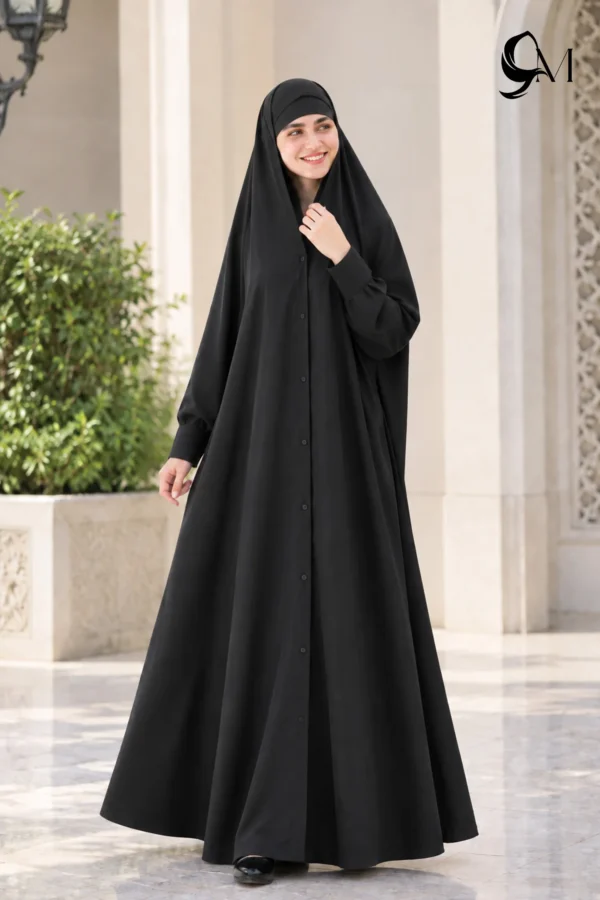
Irani Chadar with Sleeves — Complete Coverage, Both Hands Free
Managing a separate hijab, dupatta, and body covering every time you leave the house or step onto the prayer mat takes more effort than it should. Something slides, something needs pinning, and by the time you are actually ready, you have already adjusted three things twice. An irani chadar solves all of it in one garment, one motion, and under a minute.
Black Irani Chadar in Nida Fabric — Lightweight, Wrinkle-Resistant, and Travel-Ready
This Irani chadar with sleeves is stitched in formal Nida fabric, a soft, breathable, wrinkle-resistant material that drapes cleanly from head to ankle without clinging, creasing in a bag, or requiring ironing every time it comes out of the wash. At 56 inches in length with a 44-inch chest and a round-cut stitching pattern, it falls evenly over the shoulders and stays in place on windy days far better than straight-cut alternatives. The front button closure secures the entire garment without pins, leaves both hands completely free for carrying children, bags, or reading the Quran, and makes it the most practical option for Namaz, mosque visits, and long Umrah days in one breathable layer.
Irani Chadar for Women — For Prayer, Purdah, and Daily Outdoor Wear
Picture arriving at a Masjid al-Haram in Makkah and Medinah and Majlis, Najaf, Karbala, Damascus fully covered and composed, without having adjusted a single pin or readjusted a sliding dupatta since leaving home. This irani chaddar is the traditional covering preferred by Pakistani women observing full purdah, Shia women attending Imambargahs, and increasingly by college and working women who want complete modesty for mosque visits and religious events without changing their entire outfit. The black irani chadar colour is the most widely worn and culturally recognised choice across Pakistan, and the Nida fabric maintains its deep black without fading through repeated gentle machine washes. Standard free size fits chest 44 inches comfortably and is easily alterable for a more tailored fit. Mothers buying this for daughters attending religious classes, women packing for Hajj and Umrah, and those simply wanting one reliable daily outdoor covering consistently choose this irani chadar abaya style for its combination of practicality, modesty, and ease.
Irani Chadar Price in Pakistan
The current price of an Irani chadar is 5200rs. It is important to note that this price may vary based on several external factors, such as changes in manufacturing costs, market demand, and economic conditions. This means that fluctuations in these factors could lead to an increase or decrease in the irani chadar price in Pakistan over time. Buy your irani chadar online from Munawer.Pk today, with Cash on Delivery and fast delivery across Pakistan. Full coverage, zero fuss, from the first time you wear it.
Irani Chaddar: Specifications That Justify the Purchase
Why This Irani Chadar with Sleeves Delivers Complete Coverage for Daily Wear, Hajj and Religious Events
📌 FEATURE BULLETS:
- Full-length 54 inch head-to-ankle single-piece construction → this irani chadar with sleeves and buttons covers head, shoulders, chest, and body completely in one garment, replacing the separate hijab, dupatta, and abaya combination without layering
- Formal Nida fabric construction → soft, lightweight, wrinkle-resistant, and breathable, maintaining a neat pressed appearance even after being folded in a travel bag for Hajj, Umrah, or Ziyarat journeys
- Stitched sleeves with button front closure → both hands remain completely free after buttoning, practical for carrying children, reading Quran, managing luggage, or performing Tawaf in crowded Masjid al-Haram spaces
- Round-cut stitching design → distributes fabric evenly across the shoulders and body for a consistent drape that slips significantly less than straight-cut irani chadar alternatives on windy days or during outdoor movement
- Standard free size at 44 inch chest and 54 inch length → fits most Pakistani women’s heights comfortably with alteration possible for plus-size or petite adjustments without full tailoring
- Classic black colour in Nida fabric → this black irani chadar maintains deep colour across multiple machine washes when washed cold on a gentle cycle with mild detergent, addressing the colour fading complaint common with harsh detergent use on black modest wear
- No pins or additional hijab required for basic wear → an underscarf or hijab cap underneath is sufficient to secure the chadar in place, eliminating the daily pinning routine required with separate hijab and abaya combinations
- Machine washable on cold gentle cycle → practical for daily use without dry-cleaning costs, hang-drying in shade preserves both fabric structure and black colour depth across many wash cycles
- Single garment covers all modesty occasions → this irani chadar abaya functions for daily outdoor wear, Namaz, mosque visits, Imambargah majalis, madrassah attendance, and Hajj or Umrah rituals in one purchase
- Deeply culturally relevant across Pakistani Muslim women’s contexts → strong year-round demand with peak purchasing before Ramadan, Muharram, and Hajj season makes early ordering advisable to avoid stock shortages
Munawer.Pk stocks this irani chadar with sleeves online pakistan listing with actual fabric type, chest measurement, and length confirmed, directly addressing the most consistent Pakistani buyer complaint of premium product photos misrepresenting lower quality fabric delivered by unverified online sellers.
Why Irani Chadar Buyers Trust Munawer.Pk
Imagine getting ready for prayer, daily errands, or pilgrimage without the hassle of layering a separate hijab, abaya, and dupatta. With our black irani chadar with sleeves, you get complete head-to-ankle coverage in one effortless piece. Designed with tailored sleeves and front buttons, your hands stay completely free to handle bags, hold children, or carry prayer books while maintaining modest coverage. Munawer.Pk offers a transparent shopping experience backed by authentic fabric quality, open parcel verification, and fast Cash on Delivery across Pakistan.
Your Guide to Premium Irani Chadar Design & Modest Wear
| What Matters to You | Munawer.Pk ✅ | Typical Online Sellers |
| Hands-Free Functional Design | ✅ Integrated irani chadar with sleeves and buttons allowing complete mobility while keeping full body coverage secure | ⚠️ Plain traditional sheets without sleeves that require constant holding and adjustments |
| Verify Before Paying | ✅ Open box policy on Cash on Delivery with pre-dispatch verification so you can inspect stitch quality and fabric texture before paying | ❌ Sealed parcel policies preventing you from checking fabric feel or sleeve fitting before handing over cash |
| Formal Nida Fabric Comfort | ✅ Premium formal Nida fabric that is soft, breathable, lightweight, and wrinkle-resistant—ideal for travel and hot climates | ⚠️ Rough, non-breathable synthetic polyester that traps heat and creases easily inside travel bags |
| Flattering Round-Cut Drape | ✅ Expert round-cut stitching engineered to prevent slipping off the head and provide a graceful, even drape down to the ankles | ⚠️ Straight-cut fabrics that bunch up awkwardly around the shoulders and slip frequently in windy weather |
| Fair & Transparent Pricing | ✅ Honest irani chadar price in pakistan with transparent checkout costs and zero hidden fees | ⚠️ Unclear irani chadar abaya price listings with sudden delivery surcharges added at final payment |
| Sunnah-Aligned Service | ✅ Customer support guided by Islamic values with an easy 7 days returns and exchange policy | ❌ Non-existent after-sales support once the delivery courier leaves your doorstep |
| Decades of Local Heritage | ✅ 60+ years of trusted retail legacy in Pakistan as a family-owned destination for modest apparel and Hajj/Umrah essentials | ⚠️ Unregistered social media vendors showing stock photos but delivering low-grade, poorly stitched replicas |
Whether you are preparing for Hajj or Umrah, attending religious gatherings, or seeking a practical daily alternative to standard abayas, your wardrobe deserves an authentic irani chadar for women. When you choose to search for an irani chadar online pakistan option or decide to buy irani chadar online, shop with full confidence at Munawer.Pk—where modest craftsmanship meets over six decades of trusted retail heritage across Pakistan.
Irani Chadar Questions Pakistani Women Ask Honestly
Q: What is the difference between this Irani chadar and a regular abaya or dupatta?
A: Both are almost the same.
Q: Will the free size fit me properly, or is it made for a specific height range?
A: The standard size with a chest measurement of 44 inches and length of 56 inches fits most Pakistani women of average to slightly above-average height comfortably. At 56 inches length it reaches ankle level on most women between 5’2 and 5’6 in height. For very tall women above 5’7, the hem may fall slightly above the ankle rather than at it. The loose drape design means chest and shoulder width is not a fitting concern for most body types, and the fabric can be easily altered by a local darzi if the length or width needs adjusting.
Q: Is Nida fabric suitable for Karachi’s heat and humidity, or will it feel suffocating?
A: Nida is one of the better fabric choices for Pakistan’s climate precisely because it is lightweight, breathable, and wrinkle-resistant compared to heavier fabrics like jersey or thick georgette. It will feel noticeably cooler than a structured abaya in the same heat. For peak summer outdoor use in very high humidity, no full-length covering will feel completely cool, but Nida manages heat significantly better than most alternatives while still maintaining a neat, presentable drape throughout the day.
Q: Is this chadar suitable for Hajj and Umrah, and will it stay in place during Tawaf?
A: Yes, this is one of the most practical choices for Hajj and Umrah. The sleeves keep your arms covered without needing to manage the fabric, and the button closure keeps the front secure during the physical movement of Tawaf and Sa’i without requiring a hand to hold it. Wearing a light hijab underscarf or hijab cap underneath prevents the head portion from slipping during movement.
Q: Is this specific to Shia women, or is it worn by Sunni women too?
A: The Irani chadar style has strong traditional roots in Shia practice and is the standard covering at Imambargahs and Majalis gatherings. However, it is widely worn by Sunni women across Pakistan as well, particularly for Namaz, mosque visits, Umrah, religious events, and daily outdoor coverage. The garment itself carries no sectarian restriction. Any Muslim woman who wants full head-to-ankle coverage in a single, practical piece will find it equally suitable regardless of madhab.
Q: What is an Irani chadar with buttons and how is it more convenient to wear?
A: An Irani chadar with buttons features a row of buttons — typically 3 to 5 buttons — along the center front from the neckline downward, providing a closure alternative to both the traditional pin method and the zipper:
Convenience advantages of button closure:
Easy wearing and removal:
Buttons are intuitive and quick to use — the chadar can be put on and removed rapidly, which is particularly convenient for women who move between environments requiring different dress codes throughout the day
Adjustable front opening:
Individual buttons can be left open for deliberate ventilation or movement accommodation — particularly useful in Pakistan’s summer when full closure can be very warm; the wearer can unbutton from the bottom while keeping the upper buttons closed for modesty
No mechanical failure risk:
Unlike zippers which can jam, split, or break, buttons rarely fail and can be easily replaced if one is lost — extending the chadar’s usable life with simple maintenance
Cultural familiarity:
Button closures are deeply familiar in Pakistani garment culture — women accustomed to Pakistani clothing find button closures intuitive; zippers on modest outer garments are a newer convention
Aesthetic integration:
Buttons can be decorative as well as functional — pearl buttons, fabric-covered buttons, or embellished buttons on a fancy Irani chadar add an aesthetic element that zippers cannot
Q: What are the benefits of an Irani chadar with both sleeves and buttons?
A: The combination of sleeves and button closure represents the most practically complete everyday Irani chadar design — combining the coverage advantages of sleeves with the convenience and security of a closure mechanism:
Combined benefits:
- Complete coverage without auxiliary clothing requirements — sleeves handle the arms; the button closure handles the front; the full-circle or semicircular cut handles the body and head; no aspect of coverage relies on underlying clothing choices
- Fully hands-free operation — once worn and buttoned, nothing needs to be held or managed; complete freedom of movement with reliable coverage
- Appropriate for all activities — shopping, carrying children, cooking at outdoor events, attending ceremonies, using public transport — all activities are manageable without compromising coverage
- Most weather-resistant — sleeves and button closure together resist wind displacement of the covering most effectively
- Best for active outdoor use — the combination is the most practical for Pakistani women who are active outside the home
Most suitable use contexts: Daily public outdoor wear in urban Pakistani environments, religious occasions, visits to religious sites, outdoor bazaar shopping, and any situation requiring confident, maintained modest covering without constant management.
Q: The fabric looks very rich in product photos online. How do I know what I am actually receiving?
A: Mismatched product photos are the most common complaint across this category on Pakistani online platforms. The specific details to verify when your order arrives are fabric weight and texture. Genuine formal Nida has a smooth, slightly structured feel that holds its drape rather than collapsing limply. At Munawer.Pk, you can open and inspect your order before paying on COD, so check the fabric quality, stitching at the button placket, and sleeve attachment before handing over payment. If the fabric feels thin, roughly stitched at the seams, or significantly lighter than expected, then don’t accept your order.
Q: How do I wash this without fading the black colour?
A: Machine wash on a cold gentle cycle or hand wash with a mild detergent, and hang to dry in shade rather than direct sunlight, since sunlight fades black fabric faster than almost anything else. Avoid harsh detergents or bleach-based products entirely on black Nida. If ironing is needed, use low heat or iron the chadar inside out to protect the fabric surface. Do not tumble dry since heat shrinks the fabric and weakens the button stitching over time. Washing it separately from other garments on the first wash prevents any colour transfer from the black dye.
Q: What is an Irani chadar and how is it different from a regular chadar or dupatta?
A: An Irani chadar is a large, semi-circular or full-circular piece of fabric designed to cover a woman from the top of the head to the feet in a single flowing garment, originating from the Iranian tradition of the chador — the full-body covering widely worn by women in Iran. Unlike a regular Pakistani chadar, which is typically a rectangular piece of fabric used as a shawl or wrap over the shoulders and head without necessarily providing full-body coverage, the Irani chadar is specifically designed to envelop the entire body from head to floor in one continuous drape.
Q: What type of Irani chadar is most suitable and modest for women in Pakistan?
A: The most suitable and comprehensively modest Irani chadar for Pakistani women combines several features that ensure complete coverage with practical wearability:
Most modest and practical options:
Irani chadar with sleeves:
The most complete coverage option — stitched sleeves ensure the arms remain covered in all positions including when reaching, carrying items, or moving in ways that might cause a sleeveless draping to expose the arms
Irani chadar with built-in headpiece:
A design that integrates a fitted head covering — similar to a makhna — ensuring the head, hair, and neck remain covered without requiring a separate hijab or headpiece underneath
Full-circle cut:
A full-circle (360-degree) cut provides more fabric fullness and therefore more reliable coverage in all positions compared to a semicircular cut; the extra fullness means bending, sitting, and moving don’t create gaps in coverage
Opaque, heavy-enough fabric:
An adequately opaque fabric that doesn’t become transparent in bright light or when stretched — particularly important for outdoor use in Pakistan’s intense sunshine where thin fabrics become see-through
For Pakistani context specifically: Black Irani chadars in a medium-weight polyester or nida fabric with sleeves and a secure closure (zip, button, or velcro) represent the most widely adopted comprehensively modest choice among Pakistani women who wear the Irani chadar style.
Q: What is an Irani chadar with sleeves and what are its advantages over one without sleeves?
A: An Irani chadar with sleeves has stitched, full-length sleeves incorporated into the garment’s construction — typically attached at the shoulder seams of the fabric — transforming the draped covering into a more structured, garment-like outer covering:
Advantages over sleeveless:
Reliable arm coverage:
The most significant practical advantage — sleeves maintain arm coverage regardless of body movement, activities, or how the draping fabric may shift; without sleeves, any arm movement risks exposing the arms as the fabric falls away
No need for additional arm coverage:
With a sleeved chadar, the underlying clothing doesn’t need to have full-length sleeves — the chadar itself provides this coverage; sleeveless chadars require fully-sleeved underlying clothing to maintain overall modesty
Better suited for outdoor activities:
Walking, carrying bags, managing children, shopping — all activities that involve arm movement are better managed when arm coverage is reliably secured by stitched sleeves rather than relying on draping fabric
More secure in wind:
Pakistan’s variable weather — particularly monsoon wind and the strong seasonal winds of Islamabad and Peshawar — can dramatically shift draped fabric; sleeves anchor the chadar to the body more securely
Easier single-handed management:
Without needing to constantly manage the draping fabric over the arms, the wearer has more freedom for daily activities while maintaining complete coverage
Q: Is an Irani chadar without sleeves still considered a modest and complete covering?
A: Yes — an Irani chadar without sleeves is fully acceptable as a modest outer covering when worn correctly over appropriate underlying clothing. The Islamic modesty requirement is that the awrah (the body parts requiring covering in public) is covered — the chadar as a garment achieves this through its fabric coverage rather than requiring a specific construction method. The key conditions for a sleeveless Irani chadar to provide complete modesty:
Adequate underlying clothing:
The woman’s underlying clothing must have full-length sleeves since the chadar’s draping fabric doesn’t reliably cover the arms in all positions; a long-sleeved abaya, long-sleeved kurta, or similar under-layer makes the sleeveless chadar fully appropriate
Secure head and neck coverage:
The chadar must be held or arranged to maintain consistent head and neck coverage — typically by holding the front edges together under the chin or using a pin or brooch to secure it
Sufficient fabric fullness:
A large enough semicircle (at least 180 degrees, ideally full 360-degree circle) to wrap around and cover the front of the body
For everyday Pakistani use: The sleeveless style is popular precisely because it is lighter, cooler, and easier to manage in warm weather — making it the more practical choice for Pakistan’s climate for women who wear adequately covering clothing underneath.
Q: What is an Irani chadar with a zip and how does it provide a more secure fit?
A: An Irani chadar with a zip incorporates a concealed or visible zipper running from the neckline down the center front of the chadar — typically from just below the chin to approximately waist or mid-chest level. This design feature solves the primary practical challenge of the traditional sleeveless Irani chadar, which requires the wearer to hold the front edges together under the chin or use a pin to maintain closure:
Security advantages of the zip closure:
Completely hands-free wearing:
Once zipped, the chadar stays closed without any manual holding or pinning — freeing both hands for daily activities; a significant practical improvement for mothers managing children, women carrying shopping, and anyone engaged in active outdoor tasks
Consistent front coverage:
The zip prevents the front edges from separating accidentally — which happens easily with a draped chadar when the arms are moved or when wind catches the fabric
No pin requirement:
Pins can open accidentally, cause injury, and require careful placement to maintain modesty; a zip eliminates this concern entirely
Neater appearance:
A zipped closure creates a smooth, clean front line rather than the gathered appearance that can result from holding or pinning
Adjustment flexibility:
The zip can be partially opened from the bottom for easier movement while keeping the top (chest and head area) securely closed — a practical option when sitting or using stairs
Q: What is an Irani rida chadar and how is it different from a standard Irani chadar?
A: A rida is a specific two-piece modest outer garment primarily associated with the Dawoodi Bohra community — a Shia Muslim community with significant populations in Karachi, other Pakistani cities, and across the Indian subcontinent. The Irani rida chadar combines elements of the rida style with the Irani chadar tradition:
What a rida is:
A rida consists of two parts — a fitted upper piece (rida ki angi or choli) that covers the upper body and a lower piece (rida ki taan or skirt) — worn together as a complete modest outer covering with specific styling associated with Bohra cultural and religious identity
How an Irani rida chadar differs from standard Irani chadar:
- The rida style typically incorporates decorative elements — embroidery, brocade borders, and distinctive styling — that reflect the Bohra community’s aesthetic traditions; standard Irani chadars tend toward minimalism
- The rida is a culturally specific garment with community identity significance beyond its function as a modesty covering
- Rida chadars are more often in two-piece construction; standard Irani chadars are single-piece
- The rida has specific cultural conventions around color and occasion that differ from the broader Pakistani Irani chadar tradition
In Pakistani context: Irani rida chadars are primarily relevant for the Bohra Muslim community concentrated in Karachi; for the broader Pakistani Muslim population, the standard single-piece Irani chadar is the more common reference.
Q: What is the difference between an Irani chadar and a regular dupatta in terms of coverage?
A: (Already answered above — please refer to “What is an Irani chadar and how is it different from a regular chadar or dupatta?” The key distinctions are size, cut, coverage completeness, and intended function — the Irani chadar is a complete outer covering garment; a dupatta is a decorative modesty accessory.)
Q: Is an Irani chadar suitable for offering namaz and does it provide full coverage during prayer?
A: A properly designed and sized Irani chadar is an excellent choice for prayer — in many ways more suitable than a standard namaz chadar because its design already addresses full-body coverage:
Why it works well for namaz:
- The full-circle or large semicircular cut provides abundant fabric that maintains coverage in all prayer positions — qiyam (standing), ruku (bowing), and sujood (prostration)
- A sleeved Irani chadar provides complete arm coverage through all positions including the raised-arms takbeer position
- The flowing fullness means the back doesn’t become exposed during sujood — a common coverage issue with poorly designed or undersized prayer coverings
What to verify for namaz use:
- Ensure the fabric is completely opaque — thin or semi-transparent fabrics don’t fulfill the coverage requirement even when the body is technically covered
- Confirm the head covering is secure and won’t slip during the movements of prayer; a zip or button closure at the front helps maintain consistent head position
- The chadar must cover to the ankles at minimum in all prayer positions — check this specifically in the sujood position where the garment’s back length is most tested
Q: What makes an Irani namaz chadar different from a regular namaz chadar?
A: The Irani namaz chadar combines the traditional Irani chadar’s full-body draping design with specific features optimized for prayer use:
Design differences:
Irani namaz chadar:
- Normally available in black and no pattern (Simple)
- Based on the semicircular or full-circle Irani chadar cut
- May include a built-in makhna-style head piece for more secure head coverage during prayer movements
- Often includes a zip or button closure to maintain front coverage hands-free during prayer
- Specifically sized and cut to ensure coverage in all prayer positions — particularly sujood where coverage requirements are most demanding
- May be lighter weight than an everyday Irani chadar since it’s primarily for indoor prayer use rather than outdoor weather protection
Regular namaz chadar (Pakistani style):
- Available in printed lawn
- Often rectangular cut with a separate attached head covering
- More familiar to Pakistani women accustomed to traditional namaz chadar formats
- May include a makhna or fitted head piece in a two-piece set construction
- Available in a wider range of fabrics including heavier embroidered versions for prayer aesthetic
Nutshell: Both fulfill the same religious coverage requirement for salah.
Q: What type of Irani chadar is most suitable for a bride on her wedding day?
A: Bridal Irani chadars represent a significant and growing niche in Pakistani wedding fashion — particularly for nikah ceremonies where modesty is emphasized alongside celebratory elegance:
Most popular bridal Irani chadar styles:
Embroidered luxury Irani chadar:
- Heavy embroidery in gold, silver, or thread work on ivory, white, or cream base fabric
- Often in velvet, silk, or premium chiffon with gota, dabka, or zardozi embroidery
- The embroidery concentrated on the border and edges creates a framing effect that is elegant in photographs
Color-coordinated bridal chadar:
- Matching or complementary to the bridal dress color — if the bride wears a maroon lehenga, the Irani chadar might be maroon with gold embroidery
- Creates a cohesive, deliberately styled bridal look rather than a standard black everyday chadar
Embellished net or chiffon:
- Sheer or semi-sheer luxury fabrics with heavy embellishment; worn over a fully opaque undercovering
- Provides the visual beauty of fine fabric with modesty through layering
What makes a bridal Irani chadar special:
- The scale and quality of embellishment significantly exceeds everyday chadars
- Special fabrics — silk, premium chiffon, high-quality velvet — rather than the polyester of everyday chadars
- Often custom-made or tailored to coordinate specifically with the bridal outfit
- In Karachi and Lahore, specialty Islamic fashion boutiques create bespoke bridal Irani chadars
Q: What are the most popular bridal Irani chadar styles for nikah and wedding ceremonies?
A: (Already answered above — embroidered luxury styles, color-coordinated options, and embellished net/chiffon are the primary bridal styles.)
Q: What is an Irani nikah chadar and how is it traditionally worn during a nikah ceremony?
A: An Irani nikah chadar is a specifically bridal, ceremonially significant version of the Irani chadar worn by the bride during her nikah (Islamic marriage contract ceremony):
Cultural significance:
In Pakistani Islamic tradition, the nikah ceremony is the most religiously significant moment of the wedding — the bride’s appearance at this ceremony typically reflects the highest level of modest dress; the Irani nikah chadar fulfills both the religious modesty requirement and the ceremonial beauty expectation simultaneously
Traditional wearing during nikah:
- The chadar is placed over the bride’s head and arranged to drape over her fully — typically with both the front edges held or pinned to keep the face visible while maintaining coverage
- In some Pakistani traditions, the chadar is placed on the bride’s head by a respected elder female family member as a gesture of blessing and transition into married life
- During the nikah itself, the bride remains covered throughout the proceedings
- The chadar may be held in place by family members during photography to maintain the arranged draping
Design for nikah use:
- Generally more heavily embellished than everyday Irani chadars
- White, ivory, cream, or in the bride’s wedding color family
- Large enough to cover the full bridal outfit — often a longer and wider cut than everyday chadars to accommodate the volume of bridal clothing underneath
Q: What is the difference between an Irani chadar and a burqa in terms of coverage and style?
A: Both the Irani chadar and the burqa provide full-body covering for women but differ significantly in construction, aesthetic, and regional association:
Irani chadar:
- A single piece of fabric (semicircular or circular) draped over the head and body
- No stitched body structure — the coverage comes from the draping of the fabric
- Face is typically uncovered (though the wearer may choose to add a niqab)
- More fluid and flowing in appearance; the fabric moves naturally
- Associated with Iranian/Persian cultural tradition
- Holding or pinning the front is the traditional closure method (though modern versions have zips/buttons)
- Reveals the general body shape through the draping
Afghan/Pakistani-style burqa (shuttlecock burqa):
- A fully stitched garment with a structured body covering from head to floor
- Includes an embroidered mesh screen covering the eyes — the face and eyes are covered by this mesh panel
- No choice about face coverage — face covering is integral to the design
- More structured appearance; the pleated skirt creates volume
- Associated with Afghan Pashtun culture; widely worn in KPK and Afghan refugee communities in Pakistan
- Put on over the head like a structured garment
Arabic-style niqab and abaya:
- The abaya is a stitched open-front robe; the niqab is a separate face veil
- Each component is separate and distinct
- More structured garment construction
Coverage comparison:
The Afghan burqa is the most complete coverage including the eyes behind a mesh screen; the Irani chadar leaves the face uncovered unless a separate niqab is added; the abaya with niqab also leaves the eyes visible
Q: What is an Irani chadar abaya and how does it combine features of both?
A: An Irani chadar abaya is a hybrid garment that combines the flowing, head-to-floor coverage philosophy of the Irani chadar with the structured, stitched garment construction of an abaya:
Construction characteristics:
- Fully stitched — unlike the traditional draped Irani chadar, the chadar abaya has a constructed body with defined structure
- Head covering integrated — either an attached hood, a makhna-style headpiece, or an integrated scarf panel that provides automatic head coverage when worn
- Open-front design like a traditional abaya — worn by putting over the head or slipping on with front closure
- Full-length to the floor — maintains the Irani chadar’s complete floor-length coverage
- May include sleeves — making it a complete covering garment requiring no additional clothing for coverage
How it differs from a standard abaya:
- The integration of head covering distinguishes it from a standard abaya which requires a separate hijab
- The flowing, less tailored silhouette is more reminiscent of the Irani chadar’s draping aesthetic than the fitted or semi-fitted Arabic abaya silhouette
Who wears it:
- Pakistani women who want the comprehensive coverage of an Irani chadar with the structural convenience of a stitched garment
- Women who find the traditional draped Irani chadar difficult to manage but want equivalent coverage
Q: What is an Irani chadar with niqab and is face covering required when wearing one?
A: An Irani chadar with niqab is a combined set consisting of the standard Irani chadar plus a matching niqab (face veil) — either attached or as a coordinated separate piece:
The niqab component:
- A face covering that covers from below the eyes (or including the eyes in the full niqab style) to the chin and sides of the face
- Attached niqab versions are sewn directly onto the chadar at the forehead area and can be flipped up when not needed
- Separate matching niqab versions come as a coordinated set
Is face covering required?
This is a question of Islamic scholarly opinion rather than unanimous ruling:
The majority scholarly position (Hanafi, Maliki, Shafi’i): Covering the face is not obligatory (wajib) for Muslim women; it is considered a recommended act of additional modesty (mustahabb) that carries spiritual merit but is not a condition of valid modesty compliance
Minority scholarly position (some Hanbali scholars): Face covering is obligatory; the niqab is part of the required modesty covering
Pakistani scholarly consensus: The predominant Pakistani Islamic scholarly position follows the majority view — face covering is not obligatory but is virtuous; wearing an Irani chadar without the niqab is fully appropriate
For women who wear niqab: Having a chadar with an integrated or matching niqab provides a complete, coordinated modest covering set; the niqab reflects personal religious practice and commitment rather than being a universal requirement
Q: How does an Irani chadar work as a hijab and does it provide complete head and body coverage?
A: The Irani chadar functions as a comprehensive hijab (modest covering) by covering both the head and the body simultaneously in a single garment — making it one of the most complete single-piece hijab solutions available:
Head coverage:
The top of the Irani chadar is placed at the hairline or slightly forward on the head; the fabric drapes over and around the head covering hair, ears, and neck completely; when held or pinned at the front, it maintains this head coverage
Body coverage:
The semicircular or circular cut creates enough fabric fullness to cover the shoulders, arms (in sleeved versions), chest, back, and front completely down to the floor
How it compares to other hijab styles:
- Versus a separate hijab + abaya combination: The Irani chadar provides equivalent coverage in a single garment rather than requiring separate headscarf and body covering — simpler but requiring more management of the draping
- Versus a khimar (cape-style hijab): The khimar covers the head and upper body but not the lower body; the Irani chadar extends floor-length
Coverage in the Islamic sense:
The Irani chadar, when properly worn, covers all of the awrah (the body parts requiring covering in public for women) according to the majority scholarly interpretation — making it a complete Islamic modest covering in one garment
Q: What is a Shia-style Irani chadar abaya and how is it traditionally worn?
A: The Shia-style Irani chadar abaya is closely associated with the modest dress tradition of Shia Muslim women — particularly those influenced by Iranian Islamic dress conventions following the 1979 Islamic Revolution in Iran:
Traditional characteristics:
- Typically black — the standard color in Iranian Shia tradition; reflects simplicity and uniformity of modest dress
- Full-circle or large semicircular cut providing maximum coverage
- Often in a flowing, lightweight fabric (typically polyester crepe or similar) that drapes elegantly without excessive weight
- Face uncovered as is standard in Iranian practice (niqab is not traditionally part of Iranian Shia dress culture)
- The edges may be held at the front or the woman may hold the chadar in place using her hands or teeth in the traditional manner — without a closure mechanism in the most traditional form
Traditional wearing method:
- Place the center of the top edge at the hairline
- Allow the fabric to flow over the head and around the body
- Hold the front edges together under the chin or at chest level
- The hands may hold the edges together, freeing them only when using both hands is necessary — at which point the teeth traditionally hold the edges in place momentarily
In Pakistani context:
Worn by Shia Muslim women in Pakistan — concentrated in Karachi, the southern Punjab, and communities in major cities — particularly for religious occasions, visiting shrines, attending majalis, and formal religious functions during Muharram and other significant Shia religious observances.
Q: What is the difference between an Iraqi abaya and an Irani chadar abaya?
A: Both are full-body modest covering garments but reflect distinct cultural and aesthetic traditions:
Iraqi abaya:
- Traditionally a long, flowing black cloak worn open-front with a matching headscarf
- Made from a specifically lightweight, shiny fabric — typically a smooth polyester with a slight sheen distinctive to the Iraqi abaya tradition
- The fabric has a characteristic drape and movement that is lighter and more fluid than typical abaya fabrics
- Often with decorative elements at the cuffs and edges in the more elaborate versions
- Worn with a matching black headscarf that frames the face
- Associated with Iraqi and Levantine cultural modesty traditions
- The front is open and held together at the chest; no closure mechanism in the traditional form
Irani chadar abaya:
- Based on the Irani chador tradition — full-circle or semicircular cut providing all-around coverage
- Typically a matte, less shiny fabric — polyester crepe or similar with more body than the Iraqi abaya fabric
- Worn by placing over the head with the coverage falling all around the body
- May have closure mechanisms (zip, button) not typical in Iraqi abayas
- More enveloping in coverage than the open-front Iraqi abaya style
- Associated with Iranian cultural and religious tradition
Key visual distinction: The Iraqi abaya has a more open, flowing, cloak-like appearance with defined front panels; the Irani chadar creates a more enveloping, tent-like silhouette.
Q: What makes an Irani chadar fancy and for what occasions is it most suitable?
A: A fancy Irani chadar elevates the basic coverage garment into an occasion-appropriate piece through specific design elements:
Elements that make an Irani chadar fancy:
Embroidery:
- Gota, dabka, zardozi, or thread embroidery concentrated at borders, edges, and the central chest area
- Hand embroidery versus machine embroidery — hand work commands higher prices and is considered more prestigious
Premium fabric:
- Velvet (for winter formal occasions), silk chiffon, georgette, or premium crepe rather than standard polyester
- The fabric’s quality is immediately visible in its drape and movement
Stone and sequin work:
- Scattered or densely applied crystal stones, sequins, or mirror work on the fabric surface
- Creates light-catching shimmer appropriate for evening and formal occasions
Lace borders:
- Delicate lace finishing at the hem and edges adds elegance without heavy embroidery
Color:
- Moving beyond everyday black to deep jewel tones (navy, burgundy, emerald) or soft neutrals (grey, ivory) for specific occasions
Most suitable occasions for fancy Irani chadars:
- Nikah and wedding ceremonies — particularly as the bride’s or close family member’s covering
- Eid celebrations — embellished chadars for Eid prayers and family gatherings
- Formal religious occasions — maulids, religious anniversaries
- Formal social events where both modesty and occasion-appropriate appearance matter
Q: What are the most popular printed designs available in Irani chadars?
A: While traditional Irani chadars are predominantly solid black, the Pakistani market has developed a wider range of printed designs that reflect local aesthetic preferences:
Popular print categories:
Floral prints:
- Small, all-over floral patterns on dark grounds — navy, dark green, or black base with subtle floral designs
- Particularly popular among younger Pakistani women who want modest coverage with visual interest
Geometric patterns:
- Symmetrical geometric designs reflecting Islamic geometric art tradition
- Available in tone-on-tone (dark print on dark ground) or with color contrast
Paisley/boteh designs:
- Traditional South Asian motif applied to chadar fabric
- Often in border format rather than all-over print
Embossed/self-print (tonal):
- The same color throughout but with a woven or printed pattern that creates texture visible in light
- More subtle than contrasting color prints; maintains the modest visual simplicity of the Irani chadar tradition
Calligraphy prints:
- Arabic or Quranic calligraphy printed on the fabric — increasingly popular for religiously motivated wearers
- Worn with awareness that Quranic text on clothing requires respectful handling
Abstract prints:
- Contemporary abstract designs popular in the younger Pakistani modest fashion market
Q: What is the correct and modest way to wear an Irani chadar?
A: The correct wearing method for an Irani chadar balances Islamic modesty requirements with the practical management of a large draped garment:
Step-by-step wearing method:
- Head placement: Hold the chadar at the center of its top edge and place this center point at the hairline — this ensures equal fabric distribution on both sides of the head and body
- Head coverage: Allow the fabric to fall over the head, covering hair, ears, and neck completely; the fabric should come forward enough to frame the face without exposing any hair at the front
- Front closure: Bring the two front edges together under the chin or at the mid-chest level; the traditional method is holding them together in one hand; modern method is using the built-in zip, button, or pin
- Body draping: Allow the fabric to fall naturally over the shoulders and body; a full-circle cut distributes the fabric evenly around the body providing complete coverage
- Length check: Confirm the chadar reaches the floor or ankle level at the front, sides, and back; lift the arms and confirm coverage is maintained
- Movement check: Perform a brief movement check — reach forward, bend slightly, check that no gaps appear at the head, front, sides, or back
For ongoing coverage management:
In a traditional sleeveless chadar, one hand typically holds the front edges together throughout use; this is why sleeved or closure-equipped chadars are more practical for active use.
Q: How do you wear an Irani chadar without sleeves while maintaining full coverage?
A: (Already answered — wear over fully-sleeved underlying clothing; hold or pin the front edges securely; choose a full-circle cut for maximum coverage. Refer to “Is an Irani chadar without sleeves still considered modest?” above for complete guidance.)
Q: How do you style an Irani chadar with a hijab for a complete and modest look?
A: While the Irani chadar itself covers the head, many women wear a hijab or al-amira (inner cap) underneath for a more polished and layered look:
The practical combination:
Inner cap/bonnet underneath:
A fitted inner cap (typically a jersey or cotton under-scarf) worn directly on the head before the Irani chadar; this prevents the chadar fabric from sliding off the hair surface and maintains the chadar in position more reliably than placing it directly on hair
Al-amira hijab underneath:
A two-piece hijab (cap plus tube scarf) worn as an inner layer; provides secure head coverage that keeps the Irani chadar positioned correctly even during movement
Color coordination:
If the inner hijab is visible at the face frame, matching it to the chadar color (both black, for example) creates a seamless, unified look; a contrasting inner hijab creates a deliberate layered effect that some women choose as a style statement
For sleeved chadar with hijab:
The inner hijab provides a clean face-framing layer; the sleeved chadar then goes over the top providing complete outer coverage; the combination is extremely neat in appearance
Q: What is the standard cutting pattern used for making an Irani chadar?
A: The Irani chadar’s distinctive coverage is achieved through its specific geometric cutting pattern — fundamentally different from a rectangular piece of fabric:
Semicircular cut (most common):
- A large semicircle with a radius of approximately 130 to 150cm (depending on the wearer’s height)
- The straight edge of the semicircle forms the top (head area) of the chadar
- A small head-opening semi-circle or straight cut at the center of the straight edge accommodates the head
- Total fabric required: approximately 2.5 to 3 meters of 150cm-wide fabric
Full-circle cut (maximum coverage):
- A complete circle with radius of approximately 100 to 120cm
- A central opening (approximately 22 to 25cm diameter) for the head
- Provides the most even fabric distribution all around the body
- Total fabric required: approximately 3 to 4 meters of 150cm-wide fabric depending on circle diameter
Head opening:
- The head opening is typically a small forward-positioned circle (not central — positioned slightly toward the front of the pattern) to ensure more fabric falls at the front and back than at the sides
- Finished with a hem, facing, or elastic casing
Border finishing:
- The curved outer edge (the hem of the chadar) is typically finished with a rolled hem, lace border, or embroidered trim
Q: What are the correct cutting and stitching measurements for an Irani chadar?
A: Standard measurements used by Pakistani tailors for Irani chadars across different heights:
For average height (160 to 165cm):
Semicircular design:
- Radius: 135cm
- Head opening at top center: 11cm radius semicircle (22cm across)
- Total diameter of the full semicircle: 270cm
- Fabric needed: 2.75 to 3 meters of 150cm-wide fabric
Full-circle design:
- Radius: 115cm (providing floor-length coverage at average height)
- Head opening: 11 to 12cm radius circle (22 to 24cm diameter)
- Positioned 3 to 4cm forward of true center to provide more front/back coverage than side coverage
- Fabric needed: 3.5 to 4 meters of 150cm-wide fabric (two fabric widths joined for the full circle)
Height adjustments:
- For heights above 165cm: increase radius by 5 to 7cm per 5cm of additional height
- For heights below 160cm: decrease radius by 3 to 5cm per 5cm of reduced height
Sleeve dimensions (if adding sleeves):
- Sleeve length: 60 to 62cm
- Sleeve width at armhole: 40 to 42cm
- Tapered to 28 to 32cm at the cuff
- Attached at shoulder level on the chadar’s fabric
Q: How is an Irani chadar with sleeves cut and stitched for proper fit?
A: Adding sleeves to an Irani chadar transforms it from a draped covering into a structured garment — requiring specific construction techniques:
Identifying the shoulder position:
- On the cut chadar (before hemming), locate the points that will sit at the shoulders when worn — typically 20 to 22cm from the center of the head opening on each side
- Mark these points as the sleeve attachment locations
Cutting the armhole:
- Cut a curved armhole opening at the marked shoulder positions — typically 18 to 20cm long and following a gentle curve
- Reinforce the armhole edge with a facing or binding before attaching the sleeve
Sleeve construction:
- Cut sleeves separately in a straight taper from 40 to 42cm at the shoulder to 28 to 32cm at the cuff
- Length: 60 to 62cm for average arm length
- The sleeve is joined at the underarm seam before attaching to the chadar
Sleeve attachment:
- Pin the sleeve cap into the armhole, distributing the sleeve cap ease evenly around the top of the armhole
- Machine stitch with a strong seam (double-stitched or overcast for durability)
- The sleeve should allow full arm raise (for namaz takbeer) without pulling the chadar from the shoulders
Neckline finishing:
- The head opening is finished before attaching sleeves — a facing, bias binding, or rolled hem based on fabric type
- Closure mechanism (zip or buttons) is installed at the center front after all other construction is complete
Q: What fabric is an Irani chadar made of?
A: Irani chadars are produced in several fabric types suited to different seasons and occasions in Pakistan:
Most common everyday fabrics:
Polyester crepe:
The most widely used fabric for everyday Irani chadars in Pakistan; medium weight, holds its shape in draping, is easy to care for (machine washable), and is available at accessible price points; the slight matte surface is appropriate for modest dress; wrinkle-resistant
Nida fabric:
A popular modern modest fashion fabric — lightweight polyester with a smooth, matte finish; excellent drape; holds color well; the most popular fabric in contemporary Pakistani Irani chadar production
Chiffon:
Lightweight and flowy; used for summer or occasion Irani chadars; typically requires layering for adequate opacity; beautiful drape and movement
Georgette:
Similar to chiffon but slightly heavier with a more textured surface; better drape and easier opacity than chiffon; popular for semi-formal Irani chadars
For occasion and bridal:
Velvet (winter), silk, silk chiffon, embroidered net over a lining
For namaz-specific use:
Light lawn or cotton for summer comfort; flannel or thicker cotton for winter indoor prayer use
Q: How do you wash and care for an Irani chadar?
A: Care method depends on the fabric:
Polyester crepe and nida (most common):
- Machine wash on gentle cycle at 30°C with mild detergent
- Avoid high spin speed — causes creasing
- Hang immediately after washing to prevent wrinkles setting
- Air dry in shade — direct sunlight fades black and dark colors
- Iron on medium-low heat if needed; polyester can melt under too-high iron heat
Chiffon and georgette:
- Hand wash in cool water with gentle detergent — machine washing can damage the delicate weave
- Squeeze gently to remove water — never wring
- Hang carefully over a wide surface to dry — narrow hangers create permanent shoulder marks on fine fabrics
Embroidered or embellished chadars:
- Hand wash only; immersion in water can loosen stone and sequin work
- Spot clean embellished areas with a damp cloth where possible
- Dry clean for heavily embellished occasion chadars — the safest option for preserving embroidery and embellishment integrity
Storage:
- Store flat or loosely folded rather than tightly compressed — particularly for lightweight fabrics that crease permanently under pressure
- Keep in a cotton bag or pillowcase rather than a plastic bag — plastic traps moisture that causes mildew on stored fabrics
Q: Irani chadar vs abaya — which provides more coverage?
A: Both provide comprehensive coverage when worn correctly but through different construction approaches:
Irani chadar coverage:
- Head to floor in a single draping garment
- Head coverage included in the single piece
- Coverage completeness depends on the wearer’s management of the draping — a properly worn Irani chadar covers completely; an improperly arranged one may have gaps
- Face uncovered (unless niqab is added)
Abaya coverage:
- Body from shoulders to floor — a stitched garment that doesn’t cover the head
- Requires a separate hijab/headscarf for complete head coverage
- The stitched garment construction provides more reliable, consistent coverage without ongoing management by the wearer
- Face uncovered in standard abaya design (niqab is separate)
Which provides more coverage:
When comparing an Irani chadar (including head coverage) to an abaya (without head coverage), the Irani chadar provides technically more coverage in a single garment. When comparing to a full abaya + hijab combination, coverage is equivalent — the difference is in construction method rather than total coverage area.
Practical coverage reliability:
The abaya + hijab combination provides more reliably consistent coverage throughout daily activity because the stitched construction doesn’t shift; the Irani chadar requires more active management, particularly in sleeveless versions, to maintain equivalent coverage.
Q: Is an Irani chadar suitable for all body types?
A: The Irani chadar’s draped, non-structured design is remarkably accommodating of diverse body types — which is one of its practical advantages over fitted modest garments:
Why it works for all body types:
- The full-circle or semicircular cut drapes over the body without following its contours — providing the same enveloping coverage regardless of the body shape underneath
- No waist, hip, or bust measurements affect the fit
- The only relevant measurement is height — which determines the appropriate radius of the cut
Size variations for different heights:
- Petite women (below 155cm): A slightly smaller radius (120 to 125cm) prevents excessive fabric pooling on the ground
- Average height (160 to 165cm): Standard radius (130 to 135cm) for semicircle designs
- Taller women (above 170cm): Larger radius (140 to 150cm) ensures floor-length coverage
For heavier body types:
The full-circle cut is more comfortable and provides better coverage for women with larger body frames — the additional fullness of the circle versus a semicircle accommodates greater body width without restriction or tightening
One genuine limitation:
Very petite women may find the traditional large radius Irani chadar too voluminous and difficult to manage — a scaled-down version or a chadar with sleeves and a closure is more practical in this case.
Q: Irani chadar for summer vs winter — what is the difference?
A: Pakistan’s dramatic climate difference between summer and winter requires different Irani chadar fabric choices:
Summer Irani chadar:
- Fabric: Lightweight polyester chiffon, nida in lighter weight, georgette, or lawn for the lightest option
- Weight: 80 to 120 GSM — minimal additional heat burden
- Color: While black remains standard, some women opt for dark navy or very dark grey in summer which absorbs slightly less heat than pure black
- Construction: Sleeveless versions are preferred in summer to reduce fabric layers and heat; some women choose lighter colors for home use in summer while maintaining black for outdoor use
- Breathability: Natural fiber options (lightweight cotton chadar in cream or off-white) are the coolest choice for home prayer use in summer
Winter Irani chadar:
- Fabric: Heavier polyester crepe, wool blend, velvet for formal occasions, or flannel for casual warmth
- Weight: 150 to 250+ GSM — provides thermal benefit as well as coverage
- Construction: Sleeved versions are especially practical in winter — the sleeves add a layer of warmth across the arms
- Layering: Winter chadars are worn over warmer underlying clothing; the chadar itself acts as an outer layer that blocks wind and retains body heat
Pakistani climate specific:
In Karachi’s mild winters, a standard polyester nida chadar is adequate year-round. In Lahore, Islamabad, and Peshawar, a heavier winter chadar is genuinely necessary for outdoor use in December and January.
Q: Irani chadar vs niqab — which is more modest?
A: This comparison requires clarification since these are different types of garments serving different modesty functions — they are complementary rather than comparable alternatives:
What they cover:
Irani chadar:
- Covers: Head, hair, neck, body from shoulders to floor, arms (if sleeved)
- Does NOT cover: Face
- Function: Complete outer body covering
Niqab:
- Covers: Face from below the eyes (or including the eyes in the full niqab) to the chin and cheeks
- Does NOT cover: Body (worn in addition to, not instead of, body covering)
- Function: Face covering as an additional modesty layer
Which is “more modest”:
This is a false comparison because they cover different body areas — a woman wearing an Irani chadar has her body completely covered but her face visible; a woman wearing a niqab without adequate body covering has her face covered but her body exposed. Complete modesty in the Islamic sense typically requires both body covering and (according to the majority scholarly position optionally, but according to some scholars obligatorily) face covering.
The combined approach:
Many Pakistani women who wear niqab also wear an Irani chadar — the combination covers both face (niqab) and body (chadar) for what they consider the most complete modest covering. The Irani chadar is the body covering; the niqab is the face covering; they address different aspects of modesty simultaneously when combined.
Eligibility for Returns:
You can request a return within 7 days from the date of delivery. To be eligible for a return, your item must be in the same condition that you received it, unworn or unused, with tags, and in its original packaging. You’ll also need the receipt or proof of purchase.
We recommend creating a video that showcases the unboxing of the product and provides an initial review.
Refund Process:
Upon approval of your return, we will initiate a refund to your original payment method. It may take a few business days for the funds to reflect in your account.
Return Shipping:
Customers are responsible for return shipping costs unless the return is due to a mistake on our part.
How to Request a Return:
To request a return, please contact our customer support team on WhatsApp at 0341 0738060 or email us at support@munawer.com We will guide you through the process and provide you with the necessary instructions.
If your return is accepted, we’ll send you a return shipping label, as well as instructions on how and where to send your package. Items sent back to us without first requesting a return will not be accepted.
Damaged or Defective Items or Wrong Product or Never Arrived:
If you receive a damaged or defective item or the wrong product or product that never arrived, please contact us immediately with a video or photos of the product and its packaging. We will work to resolve the issue promptly. REMEMBER: YOU MUST MAKE VIDEO WHILE OPENING A PARCEL.
For more information Click here to visit: Refund and Refund Policy
