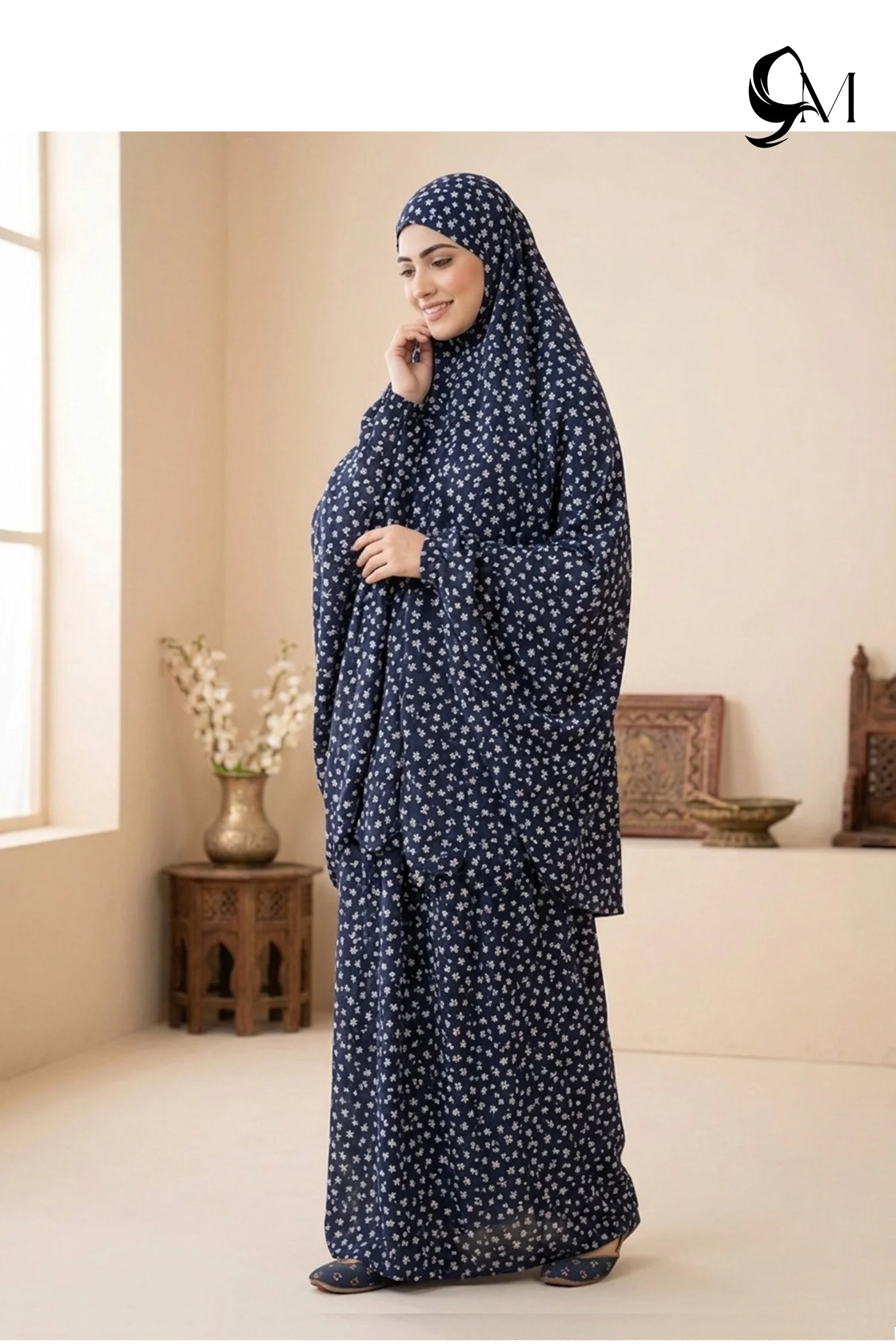
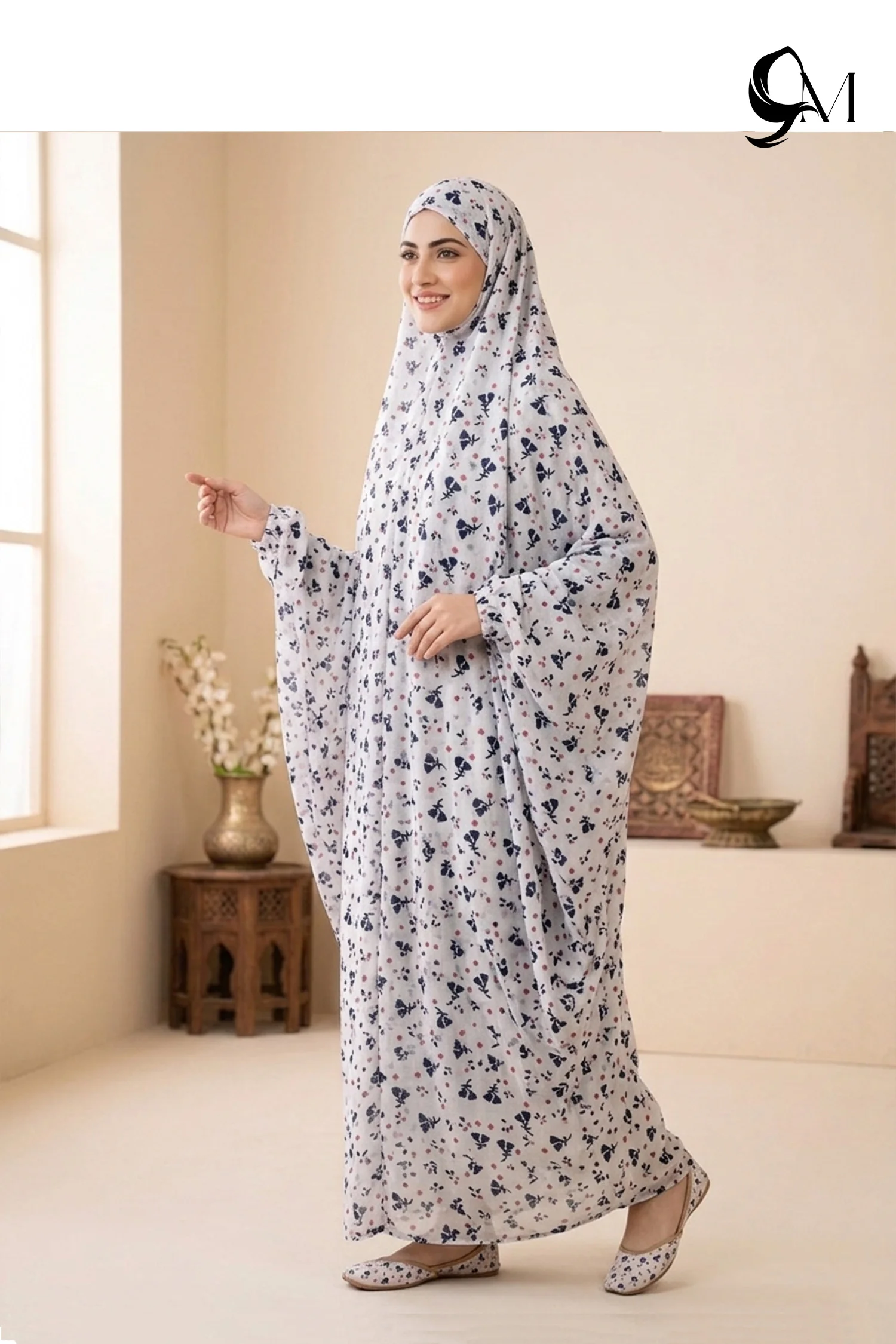
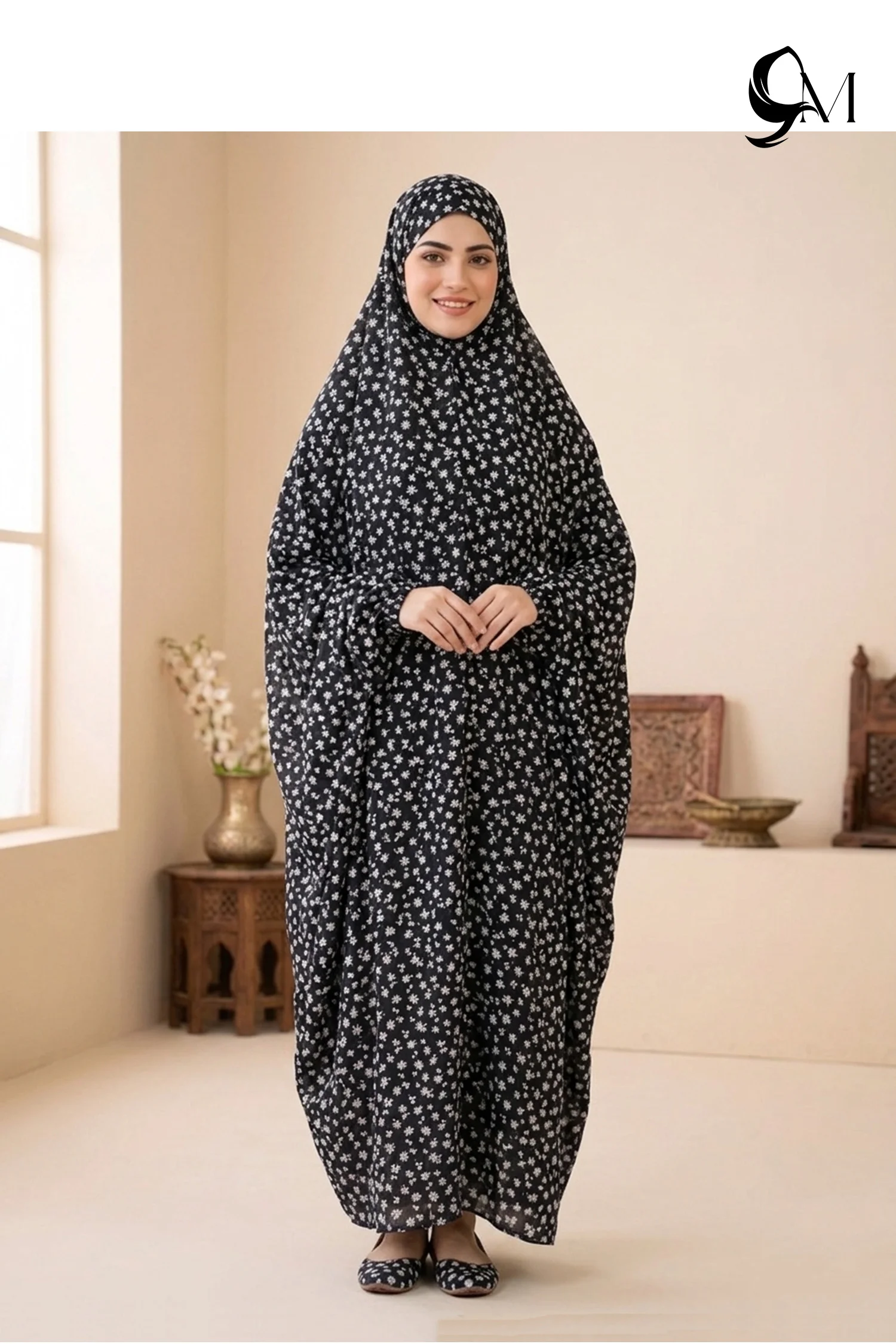
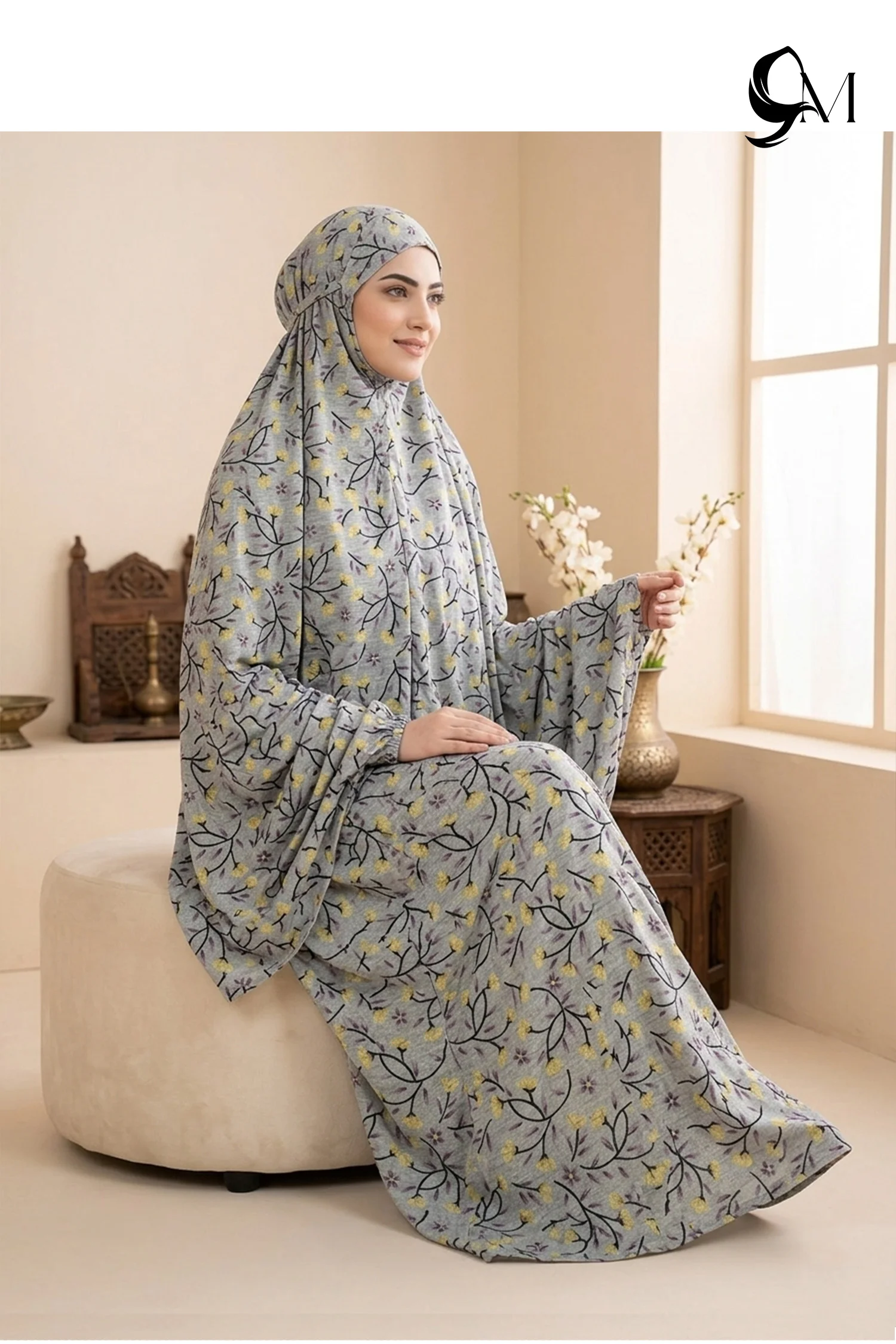
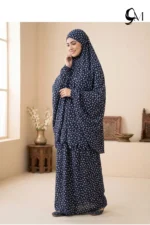
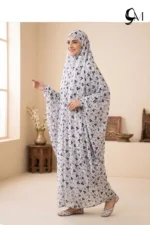
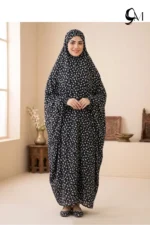
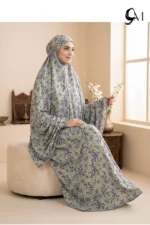
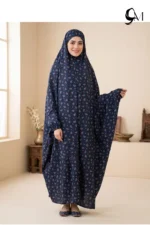
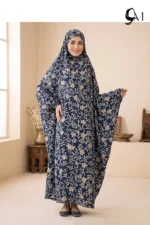
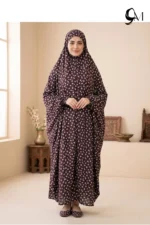



Namaz Chadar with Sleeves — Slip On, Stand Up, and Pray in Seconds
You are at home in a light shalwar kameez when the azan plays, or guests arrive unexpectedly and you need to offer Salah immediately. A regular dupatta slides off your head before the first rakat is complete, a heavy abaya is too hot to pull on just for prayer, and pinning a scarf properly takes longer than the prayer itself. There has to be a better way to be instantly ready for Salah without adjusting anything mid-prayer.
Namaz Chadar in Printed Lawn — Cool, Opaque, and Always in Place
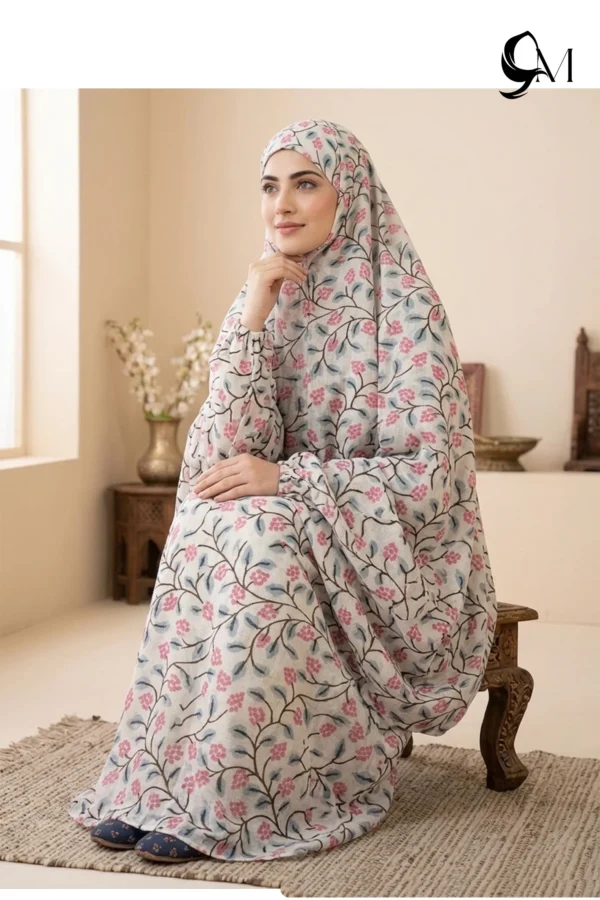
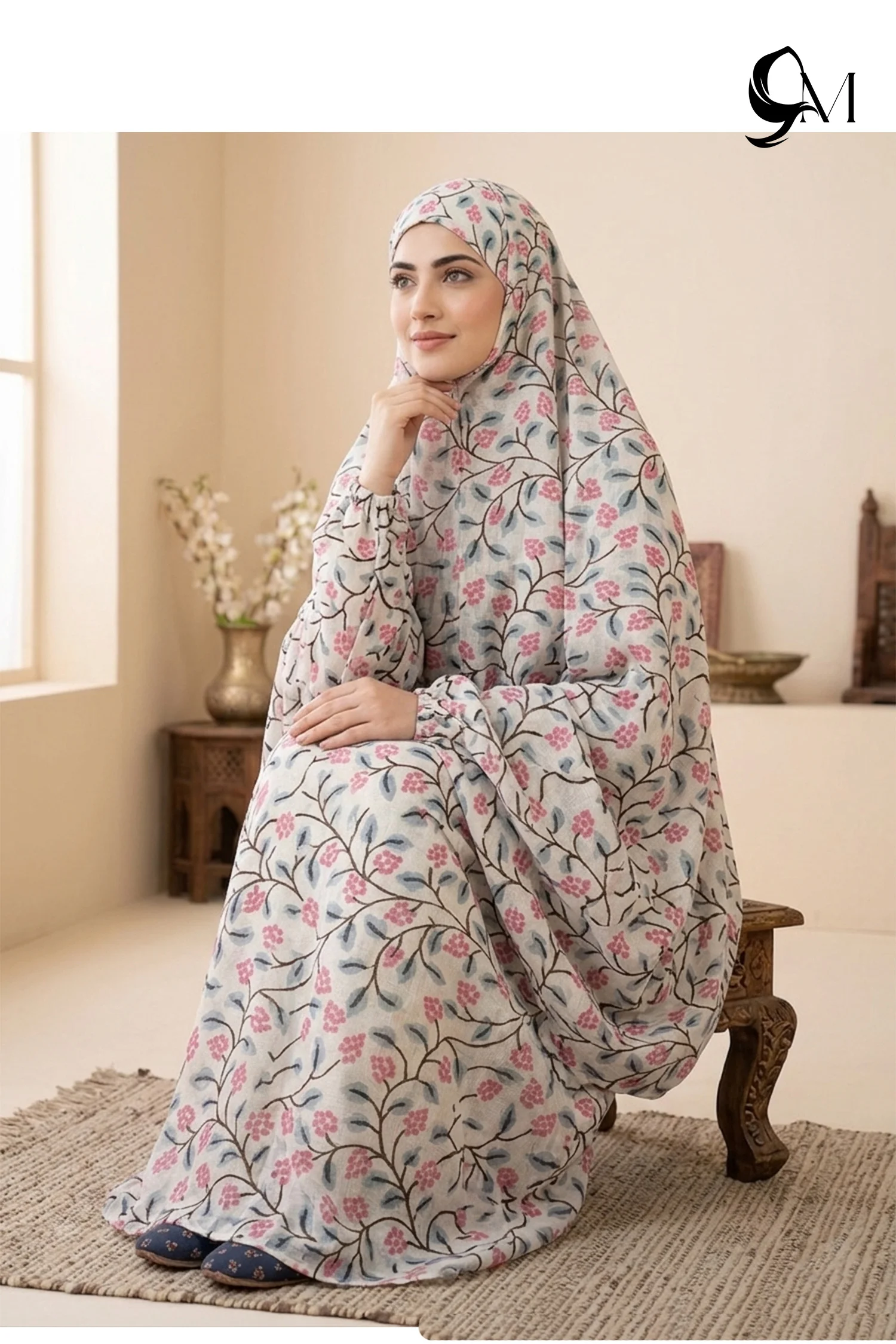
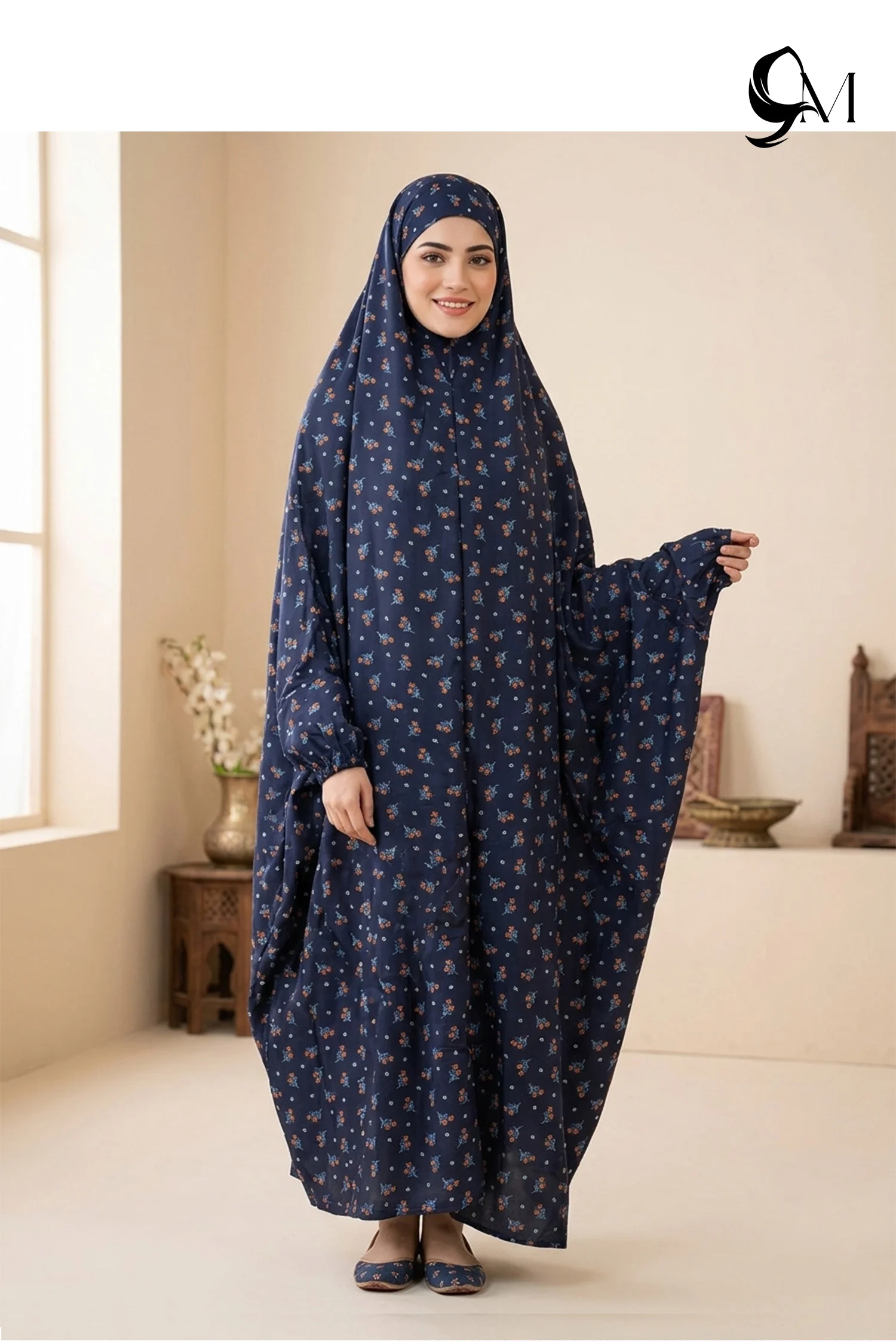
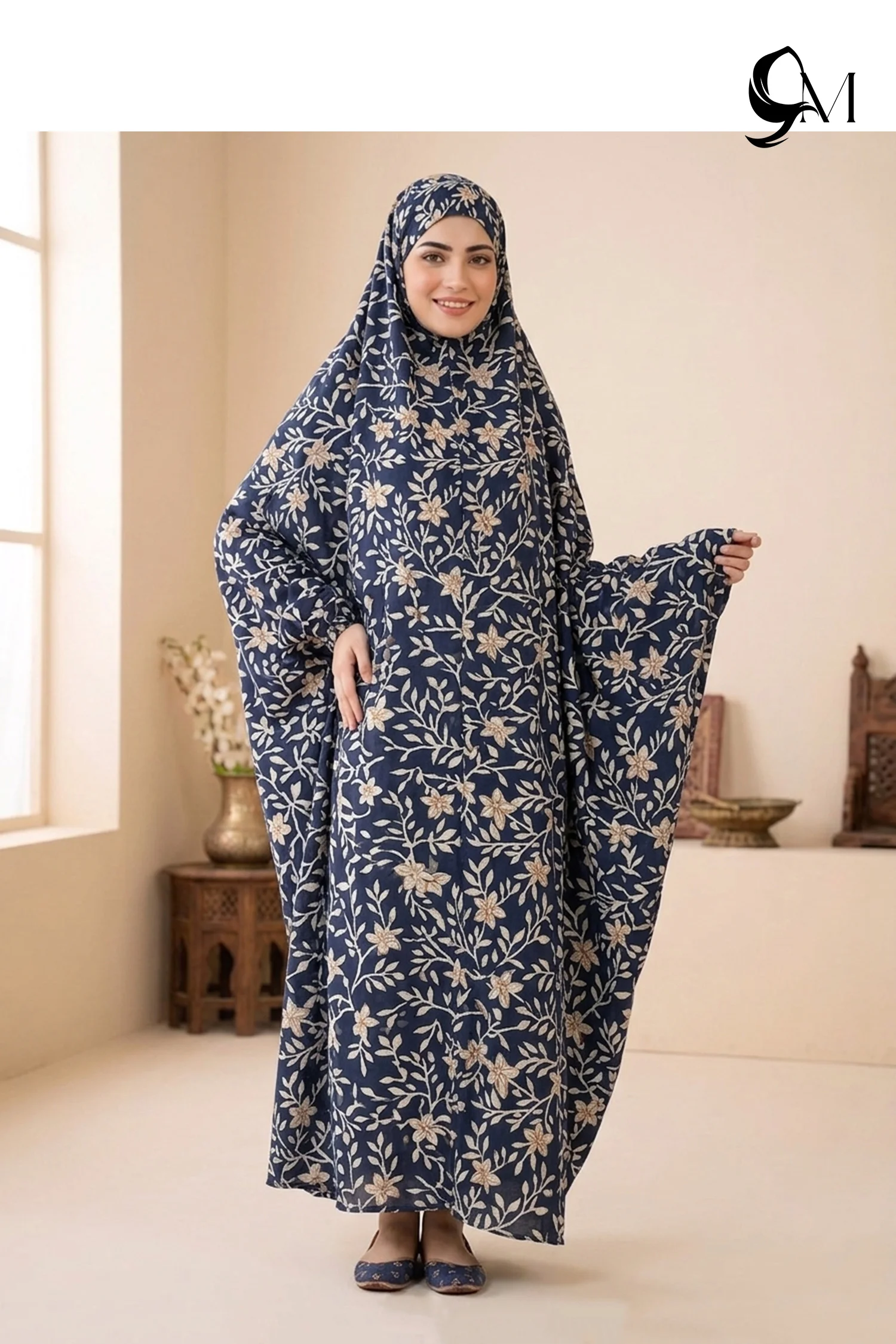
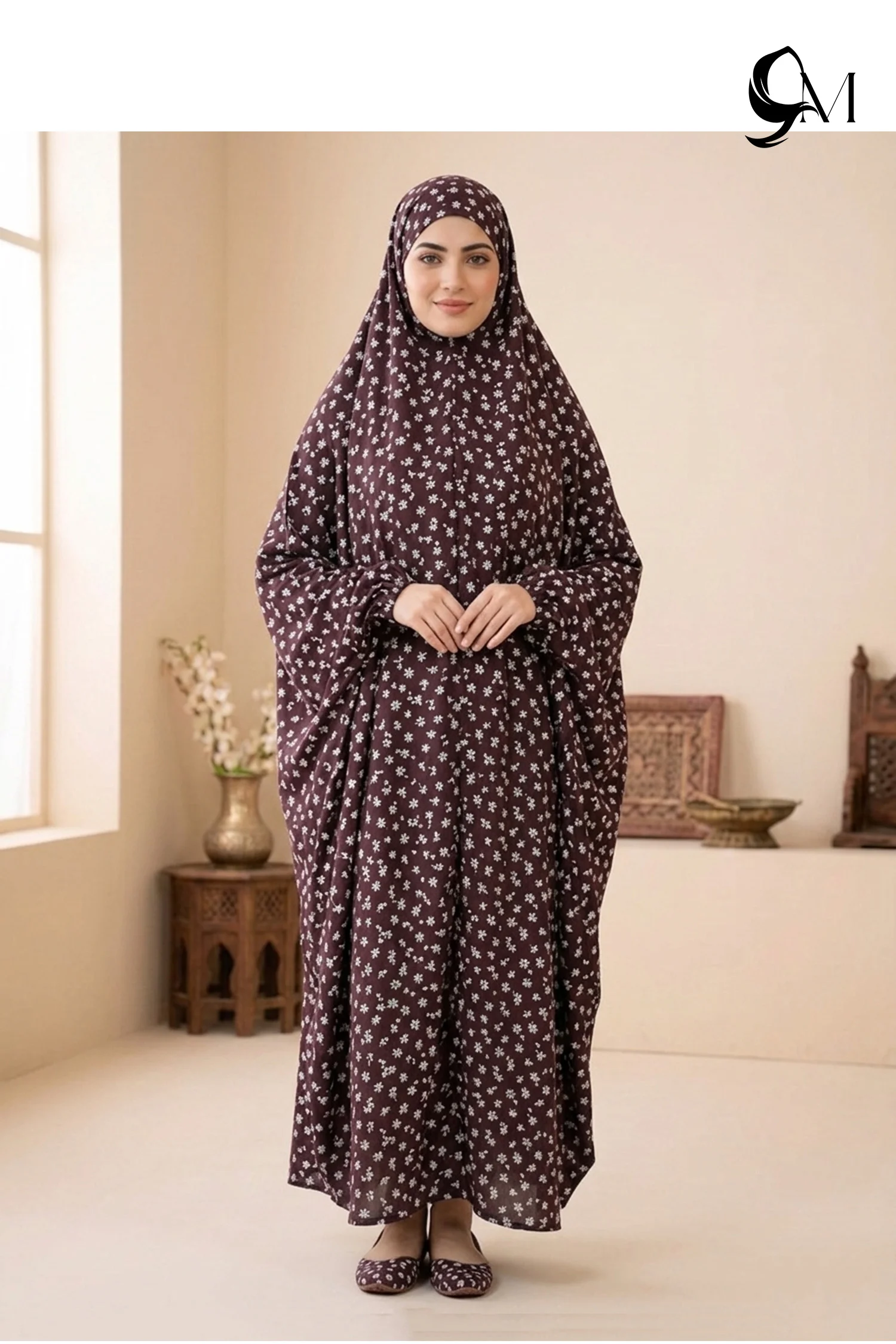
This namaz chadar with sleeves slips over your head like a hoodie in under ten seconds, with an elasticated chin band that locks the face opening in place and full elasticated sleeves that keep your wrists covered even during deep ruku and sujood. The fabric is 80% premium lawn, tightly woven to stay completely non-see-through despite being light as a feather, making it the ideal namaz chadar lawn for Pakistan's long, humid summers when heavier synthetic prayer garments become genuinely uncomfortable to wear. At 54 inches in front length and 60 inches at the back, the extended rear hem ensures full coverage during every prayer position without the chadar lifting.
Namaz Chadar for Women That Travels, Breathes, and Lasts
Picture praying Taraweeh in July without a single drop of sweat collecting under heavy fabric, or folding this lawn namaz chadar into your handbag before leaving home to use at a highway rest stop, office prayer room, or hotel room during travel. The elasticated wrist cuffs slide up instantly for wuzu and snap back into place in seconds, so your prayer routine stays uninterrupted from ablution to the final salaam. Available in soft pastel florals, polka dots, and elegant geometric prints, this namaz chadar for ladies looks modern and intentional rather than the plain white utility garment most people associate with prayer chadars. The universal free size fits heights 5'2 (Length 52 and Chest 44 Inches) comfortably; the cotton fabric is machine washable on a gentle cycle, and the interlocking seams hold through dozens of washes without fraying. Trusted by Pakistani women from Karachi to Peshawar as a Taraweeh essential, a Hajj and Umrah packing staple, and an everyday prayer companion that genuinely makes Salah simpler and more focused.
Namaz Chadar Lawn With Price
The current price of a full namaz chadar is 1599 Rs. It is important to note that this price may vary based on several external factors, such as changes in manufacturing costs, market demand, and economic conditions. This means that fluctuations in these factors could lead to an increase or decrease in the price of the namaz chadar Pakistan over time. Order your namaz chadar with sleeves online from Munawer.Pk today, with Cash on Delivery and fast delivery across Pakistan. Your prayer deserves full focus, not half your attention spent fixing a sliding dupatta.
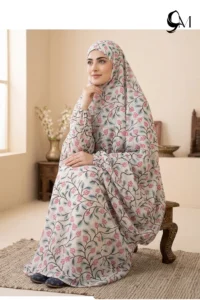
Namaz Chadar With Sleeves — What Makes It Work
-
Acrylic lawn namaz chadar fabric → provides maximum airflow and rapid heat dispersion during hot summer prayers
-
Tightly woven opaque namaz chadar cotton material → ensures full modesty without needing an extra layer underneath
-
Loose stitched elasticated sleeves → keep wrists completely covered during Sujood while sliding up easily for Wudu
-
Extended 60-inch back length → prevents the full-length namaz chadar from lifting up during Ruku and prostration
-
Integrated 9.5-inch elastic chin band → locks the chadar namaz securely on the head without requiring pins
-
Single universal free-size (Length 52 and Chest 44 Inches) → offers an easy-fitting full coverage namaz chadar for heights between 5’2″
-
Interlocking double-stitched seams → withstand frequent machine washing without fraying, delivering exceptional long-term value
-
Compact lightweight roll-down design → packs into small travel bags for convenient daily use at offices or rest stops
-
Available across Pakistan via namaz chadar pk → delivers 100% original, verified quality at an affordable namaz chadar price
Verified authentic product sourced directly for buyers seeking namaz chadar in pakistan — available online exclusively at Munawer.Pk with fast home delivery.
Real Questions About Namaz Chadar With Sleeves — Real Answers
Q: Is the printed lawn namaz chadar with sleeves sold on Munawer.Pk 100% pure cotton and completely non-see-through?
A: It is made from 80% lightweight cotton and acrylic lawn that is tightly woven to remain completely opaque, printed, and non-see-through even under bright household lights.
Q: Will this full coverage namaz chadar fit me properly if I am short or tall?
A: This is a universal single-size full coverage namaz chadar engineered to fit women between 5’2″ height. The front length measures 54 inches, ensuring the hem never lifts up or exposes your feet during Ruku and Sujood. If you are under 5’2″, the fabric drapes comfortably over your feet without tripping you, and the elastic chin band ensures the face opening (9.5 to 10 inches) stays firmly in place regardless of head size.
Q: How do the stitched sleeves work for Wudu and prayer?
A: The best namaz chadar with sleeves features soft, loose-fitting elasticated cuffs that sit comfortably at your wrists during prayer to keep your arms fully covered during prostration. When it is time for Wudu, the flexible elastic allows you to quickly push the sleeves up past your elbows without stretching out the stitching or unpinning any fabric.
Q: Is this lawn namaz chadar convenient for hot Pakistani summers and Taraweeh?
A: Yes, the lightweight lawn namaz chadar is specifically crafted for Pakistan’s humid summer climate, load-shedding hours, and lengthy Taraweeh or Umrah prayers. Unlike heavy abayas or slippery georgette dupattas, the pure cotton fibers wick away sweat quickly and offer maximum airflow to keep you cool.
Q: Will the pure cotton shrink or fade after machine washing?
A: Pure cotton lawn can shrink up to an inch if exposed to boiling water or high heat, so always wash your chadar namaz in cold or lukewarm water on a gentle cycle. The soft floral prints are yarn-dyed to resist fading, but to keep the cotton crisp and long-lasting, avoid bleach, do not wring harshly, and line-dry in the shade before ironing on medium heat.
Q: How does this slip-on style compare to a traditional irani namaz chadar without sleeves?
A: Traditional irani namaz chadar options and a standard namaz chadar without sleeves require you to constantly hold the fabric shut with your hands or secure it with safety pins to avoid slipping off during prayer. This stitched sleeve design slips on instantly like a hoodie, locking onto your head with an elastic chin band and keeping your hands free so you can focus entirely on your Khushu in Salah.
Q: How much does a namaz chadar price in Pakistan usually run, and how fast is delivery from Munawer.Pk?
A: The namaz chadar price in pakistan varies by fabric quality, but pure lawn stitched variants offer the best balance of durability and comfort. Standard Cash on Delivery (COD) orders across Pakistan arrive at your doorstep in 4 to 6 working days, and at Munawer.Pk, you can open and verify your parcel before paying on COD. For urgent needs, we also offer fast overnight air shipping for prepaid orders, delivering within 2 to 3 working days (Sundays excluded).
Q: What is a namaz chadar and what is its role in a woman’s prayer routine?
A: A namaz chadar is a dedicated prayer covering worn by Muslim women during salah to fulfill the Islamic requirement of covering the awrah (the parts of the body that must be covered during prayer). It is a loose, flowing garment like abaya or an irani chadar — designed to cover the entire body from head to foot except the face and hands, ensuring that a woman can offer her prayers with complete modesty and without the distraction or concern of checking whether her regular clothing provides adequate coverage.
Q: What type of namaz chadar is most suitable and modest for ladies?
A: The most suitable and modest namaz chadar for ladies combines complete coverage, ease of wearing, and practical comfort during the physical movements of prayer:
- Full-length design covering from head to ankles or floor-length with no gaps in coverage during all prayer positions including ruku and sujood
- Sleeve coverage that keeps the arms covered during all positions — particularly important during ruku when a sleeveless chadar may cause the arms to become exposed
- Secure head coverage that stays in place without constant readjustment — a fitted or elasticated head opening or a makhna-style attached headpiece significantly improves stability
- Adequate width and fullness so that when kneeling in sujood the back does not become exposed and the feet remain covered in the sitting position
- Opaque fabric that doesn’t become see-through in bright light or when stretched — double-layered or thick enough fabric prevents transparency during prayer
For Pakistani women specifically, a lawn or cotton full-length chadar with sleeves and a secure head opening is the most commonly preferred choice for daily home prayer use throughout most of the year, shifting to thicker fabrics in winter months.
Q: What should women look for when choosing the right namaz chadar for daily prayers?
A: The key selection criteria for daily use:
Coverage:
- Length should reach the ankles or floor — no gap of skin showing at any position
- Width should be generous enough that kneeling and prostrating doesn’t create pulling that shortens the back coverage
- Head coverage should be secure and complete
Practicality:
- Easy to put on and take off quickly — a woman offering five daily prayers needs to wear and remove the chadar multiple times throughout the day
- Machine washable — daily use demands easy maintenance
- Wrinkle-resistant — a chadar that requires ironing before every prayer creates a practical barrier to consistent prayer use
Comfort:
- Breathable fabric appropriate to the season — cotton or lawn for summer; light wool or flannel for winter
- Lightweight enough that it doesn’t feel cumbersome during the physical movements of prayer
- Not too loose that it constantly needs readjustment during ruku and sujood
Modesty:
- Completely opaque in all lighting conditions
- No decorative elements that distract during prayer
- Neutral or modest colors and designs appropriate for worship
Q: What is the difference between a namaz chadar with sleeves and one without sleeves?
A: The difference is primarily functional and relates to coverage during the movements of prayer:
Namaz chadar with sleeves:
- Has stitched sleeves (full-length) that keep the arms covered regardless of how the arms are raised or positioned during prayer
- Provides secure, reliable arm coverage during all prayer positions — qiyam (standing), ruku (bowing), sujood (prostration), and sitting
- More like a full prayer garment that can be worn without checking coverage
- Better suited for daily use since it requires no additional adjustment for arm coverage
- Slightly warmer due to additional fabric coverage
Namaz chadar without sleeves:
- A draped or wrap-style covering without stitched sleeves; the arms are covered by the fabric falling over them when the arms are at the sides
- Coverage of the arms can become unreliable when the arms are raised during prayer — particularly during the opening takbeer (hands raised to ears) and during ruku
- Requires the wearer to ensure adequate arm coverage through the draping technique
- Simpler construction; often less expensive
- May be suitable for women who wear long-sleeved clothing underneath and only need the chadar for head and body coverage
For reliable and complete coverage during all prayer positions, the sleeved version is the more practically complete choice for most women.
Q: What makes a namaz chadar with sleeves a better choice for daily prayer use?
A: (Already answered above — sleeves provide reliable arm coverage through all prayer positions without requiring adjustment or management of fabric draping during the physical movements of salah.)
Q: Is a namaz chadar without sleeves acceptable for prayer and who is it most suitable for?
A: A sleeveless namaz chadar is acceptable for prayer provided the arms and all other required areas remain covered throughout all prayer positions. If the woman is wearing a full-length, long-sleeved garment underneath the chadar, the sleeveless chadar provides the additional coverage for the rest of the body and head while the underlying clothing handles arm coverage. It is most suitable for:
- Women who wear full-length, long-sleeved daily clothing (like a loose abaya or long kurta with sleeves) who only need the chadar for head and outer coverage
- Warmer climates where minimizing fabric layers is a comfort consideration
- Travel use as a lighter-weight, more compact packing option when the underlying clothing is already adequately covering
Q: What are the benefits of wearing a full-length namaz chadar during prayers?
A: A full-length namaz chadar — one that covers from the crown of the head to the feet — provides comprehensive benefits for prayer:
Religious completeness:
- Ensures the awrah is fully covered in all positions without any risk of exposure at the ankles, wrists, or back
- Provides confidence and peace of mind during prayer — the woman can focus entirely on the spiritual engagement of salah rather than concerns about coverage
- Fulfills the scholarly consensus on the required coverage for women’s salah without any ambiguity
Practical benefits:
- Works as a complete prayer covering over any type of everyday clothing — the woman doesn’t need to be already wearing specific prayer-appropriate clothing
- Allows women to quickly transition from any activity to prayer without a full wardrobe change
- Covers potential gaps in coverage that might exist in the woman’s regular clothing during the physical movements of prayer
Q: Why is a full coverage namaz chadar preferred for offering prayers at home or in a mosque?
A: (Already answered above.)
Q: What is a namaz chadar with niqab, and is it necessary to cover the face during prayer?
A: A namaz chadar with niqab is a prayer covering that includes an attached face veil in addition to the standard body covering. Regarding the Islamic ruling on covering the face during prayer:
The scholarly consensus: Covering the face is not required during prayer according to the majority of Islamic scholars. The face is not part of the awrah that must be covered during salah — a woman praying with her face uncovered is offering a valid, complete prayer.
Why some women choose a chadar with niqab:
- Women who observe niqab as part of their regular practice may feel more spiritually comfortable maintaining face covering during prayer as well, even though it is not required
- In congregation or mixed settings, some women prefer the niqab attachment for additional modesty if non-mahram men might be present
- Cultural practice in some Pakistani, Iranian, and Afghan communities where niqab during prayer is traditional
The scholarly position clearly stated: The face and hands are exempt from the awrah requirements during salah — a woman’s prayer is fully valid and complete with the face uncovered. Wearing a niqab during prayer is a personal choice and a supererogatory act of modesty, not a religious requirement.
Q: What is the difference between a namaz chadar and a prayer abaya?
A: Both serve the purpose of covering a woman completely during salah, but they differ in design and construction:
Namaz chadar:
- A draped or loosely structured covering — more like a large shawl or wrap, sometimes with minimal stitching
- Put on by wrapping or draping over the head and body
- Generally simpler in construction — often a single piece of fabric with a head opening or two-piece design
- More portable and compact for travel
- Traditional in Pakistani and South Asian Muslim culture
- Often worn over everyday clothing
Prayer abaya:
- A fully stitched open-front or pullover garment resembling a robe
- More structured with proper sleeves, a fitted or loose silhouette, and a formal garment construction
- Provides secure, reliable coverage with the structure of a stitched garment
- More common in Gulf Arab countries and increasingly popular in Pakistan
- Generally more expensive due to greater fabric and construction requirements
- Often comes in black though other colors are available
Both fulfill the same religious function when correctly designed — the choice between them is primarily cultural preference, comfort, and personal style.
Q: What is the difference between a jilbab and a namaz chadar for prayer use?
A: A jilbab and a namaz chadar serve overlapping but distinct purposes:
Jilbab:
- A loose, full-length outer garment worn in public as part of daily Islamic modest dress
- Mentioned in Quran (Surah Al-Ahzab 33:59) as the outer covering Muslim women should wear when going out
- Designed as an outer garment covering the entire body for public use
- Can be a coat-style, abaya-style, or wraparound garment depending on regional interpretation
- Worn outside the home as regular modest dress — not exclusively for prayer
Namaz chadar:
- Specifically designed for the purpose of prayer
- A home prayer garment — typically kept near the prayer space and worn specifically for salah
- Not necessarily designed for public outdoor wear
- Simpler in design — prioritizes complete coverage during prayer positions over everyday outdoor fashion considerations
Overlap: A jilbab that provides full coverage of the awrah is perfectly valid to pray in — many Pakistani women offer salah in their jilbab or abaya without needing to add a separate namaz chadar. The namaz chadar is a convenient, specifically designed alternative for women whose everyday clothing doesn’t fully fulfill prayer coverage requirements.
Q: Why is cotton considered one of the best fabrics for a namaz chadar?
A: Cotton earns its status as the preferred namaz chadar fabric through several properties ideally suited to prayer use:
Breathability: Cotton’s natural fiber structure allows air circulation, keeping the wearer comfortable during prayer in warm Pakistani summers when additional layers can cause overheating — particularly important during the longer prayers of Fajr and Isha
Skin comfort: Cotton is gentle against the skin and face — the area of the chadar near the face must be comfortable since any irritation distracts from prayer focus
Absorbency: Natural cotton absorbs perspiration during prayer, keeping the wearer dry and comfortable
Opaqueness: Good quality cotton is reliably non-transparent, ensuring coverage is complete in all lighting conditions without the transparency risk of some synthetic fabrics
Easy care: Cotton is machine washable, can be washed at higher temperatures for hygiene, and responds well to ironing — practical for a daily-use item
Year-round adaptability: Lighter cotton weaves work well in summer; heavier cotton and cotton blends provide warmth in winter
Absence of static: Unlike synthetic fabrics, cotton doesn’t generate static electricity that causes the chadar to cling to the body during prayer movements
Q: What are the benefits of choosing a lawn fabric namaz chadar for summer use?
A: Lawn fabric — the fine, lightweight cotton weave that is Pakistan’s most beloved summer textile — is particularly well-suited for summer prayer covering:
Temperature management: Lawn’s fine, open weave allows maximum air circulation, making it the coolest cotton option for summer prayer use — critical during Pakistan’s intense summer heat when temperatures in cities like Multan and Lahore regularly exceed 40°C
Lightweight feel: The lightness of lawn means the additional covering layer of a chadar feels minimal rather than burdensome in hot weather — encouraging consistent prayer observance even in extreme heat
Moisture management: Lawn absorbs sweat effectively and releases it quickly to the air, keeping the wearer feeling fresh even through multiple daily prayers
Softness: Quality lawn has an exceptionally soft hand feel that is comfortable against the face and skin
Pakistan-specific advantage: Lawn is the most widely available quality fabric in Pakistan’s textile market — available in countless colors, patterns, and qualities at a wide range of price points; namaz chadars in lawn are among the most accessible and affordable high-quality prayer garments available in the Pakistani market
Easy washing: Lawn washes easily by hand or machine, maintains its softness, and dries quickly — ideal for a daily-use prayer garment in summer
Q: What is a makhna namaz chadar and what makes it suitable for prayer?
A: A makhna is a specific headpiece design — a fitted, bonnet-like covering that covers the head, ears, and nape of the neck, typically made from the same fabric as the accompanying chadar or as a standalone piece. In namaz chadar context, a makhna chadar refers to a prayer set that includes a makhna headpiece used in combination with a body covering chadar.
What makes a makhna particularly suitable for prayer:
- Secure head coverage: Unlike a loose dupatta or draped chadar that can slip during the bowing of ruku or the repetitive movements of prayer, a makhna fits snugly and stays in place throughout all prayer positions without any manual readjustment
- No pins required: The fitted structure of the makhna means no safety pins are needed to keep it in place — eliminating the risk of pins opening during sujood and causing injury
- Complete neck coverage: The makhna covers the nape and hairline completely — an area that can be exposed when a simple dupatta is used as a head covering during prayer
- Convenience: Simply placing the makhna on the head provides instant, secure head coverage without the draping or arrangement required for a dupatta or loose chadar
- Popular in Pakistan: Makhna-style headpieces are extremely popular in Pakistani women’s prayer wear — widely available in markets and online and considered one of the most practical solutions for consistent head coverage during salah
Q: What is an Irani namaz chadar and how is it different from a regular prayer chadar?
A: An Irani namaz chadar (also called Irani chador) is a specific style of prayer covering closely associated with the full-body chador traditionally worn in Iran. Its defining characteristics:
Design:
- A large semicircular or full circular piece of fabric — no stitching except at the opening
- Worn by holding the front edges together under the chin or in the hands, or with a pin
- Covers from the crown of the head to the floor, enveloping the entire body
- No sleeves — the arms are covered by the draping fabric
- Typically in solid dark colors — black, navy, or dark grey — often in a light synthetic fabric with a slight sheen
Differences from regular Pakistani namaz chadar:
- The Irani style uses a single large piece of fabric without any body shaping or fitted elements
- Requires the hands or a pin to keep it closed at the front during non-prayer activity
- During prayer, the edges are tucked or pinned to allow hands-free movement
- More enveloping — covers more completely than many Pakistani-style chadars
- Less structured — doesn’t have the tailored elements of stitched Pakistani prayer garments
Availability in Pakistan: Irani namaz chadars are available at Islamic supply shops and on Daraz — they are popular among Pakistani women who prefer the fuller coverage and simpler design, and are often chosen for mosque use and for Umrah and Hajj.
Q: What is the standard cutting pattern of a namaz chadar for proper coverage?
A: The standard cutting patterns used for namaz chadars in Pakistan fall into a few common formats:
Two-piece stitched chadar:
- Headpiece (makhna): A fitted bonnet-style piece cut to cover the head, ears, and nape; typically an oval or rounded rectangle with elastic or tucks to create the fitted shape
- Body piece: A long rectangular panel approximately 2.5 to 3 meters long and 1.5 to 1.8 meters wide, gathered or pleated at the top to attach to the head piece; full length to floor
One-piece draped style:
- A single large rectangle or semicircle of fabric (approximately 2 to 2.5 meters × 1.5 meters) with a central head opening cut or hemmed into the fabric; no separate head piece
Full stitched garment style (similar to abaya):
- A pullover or wrap-around stitched garment with set-in sleeves and a head opening; more structured and tailored than the draped alternatives
- Pattern includes front and back body panels, full-length sleeves, and a hood or attached head covering
The critical measurement principle: In all patterns, the key measurement is that the body panel must be long enough and wide enough that when the wearer is in the sujood position — the most physically demanding coverage position — the back does not become exposed and the chadar does not pull tight across the back and shorten the front.
Q: What are the correct cutting and stitching measurements for a namaz chadar?
A: Standard measurements used by Pakistani tailors and ready-made manufacturers:
For a two-piece makhna-style set:
Makhna (headpiece):
- Length: 50 to 55cm (from forehead to below the nape of neck)
- Width: 40 to 45cm (ear to ear across the top)
- The piece is cut in an oval or elongated shape and gathered with elastic or tucks at the back to create a fitted bonnet shape
Body chadar panel:
- Length: 120 to 135cm for most average heights (floor-length measurement from shoulder)
- Width: 150 to 180cm (to ensure adequate fullness for movement without tightness)
- Attached to the makhna at the shoulder/nape line with gathering to create fullness
For a full one-piece chadar with hood:
- Total fabric length: 220 to 250cm
- Width: 150 to 160cm
- Head opening: 52 to 55cm circumference, centered in the fabric approximately 60 to 70cm from one end
- Sleeves (if included): Standard full-length sleeve approximately 60cm in length and 36 to 40cm width at the cuff
Important tailoring note: Always cut for full sujood coverage — measure the wearer’s back length from the top of the head to the floor when in sujood position, not just standing height, to determine the minimum required chadar length.
Q: How is a namaz chadar stitched to ensure full coverage and ease of wearing?
A: Key stitching considerations for a properly constructed namaz chadar:
Head opening: The head opening should be finished with a narrow hem or facing — not a raw edge that frays — and sized comfortably snug so it doesn’t slip during prayer but not so tight it is uncomfortable
Makhna attachment: When a separate makhna is included, it should attach to the body chadar at the shoulder level with secure, flat seaming that lies smooth and doesn’t create a bulky ridge that irritates the neck
Hem finishing: All hems — particularly the floor-length hem of the body panel — should be double-turned and machine stitched for durability, as this hem drags on the floor during prayer and receives significant wear
Sleeve setting: Sleeves must be set in with enough ease at the armhole that the arm can be fully raised (as in the opening takbeer) without pulling the chadar up from the body
No elastic at body: Avoid elastic at the waist or body level — elastic creates tightness that pulls the chadar during movement and can cause the back to become short in sujood
Allowance for sujood: The most important structural consideration — the back panel must have sufficient length that kneeling forward in full sujood doesn’t pull the back of the chadar tight and expose the ankles or feet
Q: What fabric is best for namaz chadar?
A: (Already answered — cotton and lawn are the best fabrics for summer use; flannel, light wool, or cotton blends work better for winter. The key requirements for any namaz chadar fabric are opacity, breathability, skin comfort, and washability.)
Q: How do you wear a namaz chadar properly?
A: The correct wearing method depends on the style:
For a two-piece makhna and chadar set:
- Place the makhna on the head like a bonnet, ensuring all hair is tucked in and the ears and nape of neck are fully covered
- Drape the body panel over the makhna, ensuring it falls evenly on all sides
- Check that the front, back, and sides all reach the floor or ankle level
- Perform a quick coverage check — raise arms as if in takbeer, bow forward as in ruku, and check that no skin or hair is visible at any point
For a one-piece chadar with central head opening:
- Place the head opening over the head, settling it comfortably at the hairline
- Arrange the fabric so coverage falls evenly — front panel and back panel approximately equal length
- If the chadar has sleeves, insert arms; if no sleeves, arrange fabric over the arms
- Pin at the chest if the front tends to open
For an Irani-style chador:
- Hold the fabric at the center of the top edge
- Place the top edge at the hairline and drape the fabric over the head and shoulders
- Hold the front edges together under the chin or pin at the collarbone
- Ensure the fabric reaches the floor all around
Q: Is it necessary to wear a namaz chadar for prayer?
A: It is not specifically the namaz chadar as a garment that is required — what is required by Islamic law is that a woman’s awrah is fully covered during prayer. The awrah of a woman in prayer (according to the Hanafi school predominant in Pakistan) is the entire body except the face and hands. A namaz chadar is one convenient way to fulfill this requirement — but it is not the only valid way. A woman praying in clothing that already covers her completely — a loose abaya, a full-length jilbab with long sleeves, or appropriately covering everyday clothes — is fulfilling the prayer’s coverage requirement without needing an additional chadar.
Q: What is the difference between a namaz chadar and a prayer abaya?
A: (Already answered — refer to “What is the difference between a namaz chadar and a prayer abaya?” above.)
Q: How do you wash and care for a namaz chadar?
A: A namaz chadar requires regular washing given its daily use in close contact with the face and body:
Washing:
- Cotton and lawn chadars: Machine washable on a gentle or regular cycle at 30 to 40°C; use mild fragrance free detergent to avoid skin reactions from residual fragrance against the face during prayer
- Wash with similar colors — prayer chadars in white or light colors should never be washed with dark clothing
- Do not bleach unless the chadar is white and the fabric care label permits — bleaching weakens cotton fibers over time
Drying:
- Air dry flat or on a hanger away from direct intense sunlight — prolonged sun exposure fades colors and weakens fabric
- Cotton and lawn dry quickly in Pakistan’s climate — usually within a few hours outdoors
Ironing:
- Most cotton and lawn chadars benefit from ironing — a smooth, unwrinkled chadar drapes better during prayer and provides more reliable coverage than a heavily wrinkled one
- Iron at the appropriate temperature for the fabric type
Storage:
- Fold neatly and store in a clean, covered location near the prayer area
- Keep away from perfume, incense, or cooking smells that would make the chadar strongly scented — some scholars advise keeping prayer garments free of strong fragrances
Q: What is the namaz chadar size guide?
A: Our namaz chadar size is Length 52 and Chest 44 Inches
Q: Can you use a dupatta instead of a namaz chadar for prayer?
A: A dupatta can be used for prayer provided it fulfills the coverage requirements — meaning it covers the head, neck, and enough of the body and arms that the awrah is not exposed in any prayer position. The practical challenges with using a dupatta as a prayer covering:
Coverage limitations:
- A standard dupatta typically covers the head and shoulders but leaves the arms, back, and lower body uncovered — making additional clothing coverage essential
- During ruku and sujood, a dupatta slips and shifts easily, potentially exposing the hair or neck
Practical challenges:
- Requires constant readjustment during prayer — distracting from spiritual focus
- Generally less reliable than a dedicated prayer chadar for maintaining coverage through all positions
When a dupatta is acceptable:
- If the woman is already wearing fully covering clothing (long sleeves, ankle-length garments) and only needs the dupatta for head coverage — this is a valid approach
- If the dupatta is large enough to drape over the head and body adequately
The scholarly guidance: What matters is coverage, not the specific garment used. A dupatta that fulfills the coverage requirements is valid; one that doesn’t is insufficient regardless of being a traditional garment.
Q: What is the Islamic ruling on wearing a namaz chadar in Islam?
A: The Islamic ruling on women’s prayer covering is well-established across all major schools of jurisprudence:
The requirement: A Muslim woman must cover her entire body except the face and hands during salah. This is a shart (condition) of the validity of salah — meaning prayer offered with the awrah uncovered is not valid and must be repeated.
The evidence: This ruling is established through the hadith of the Prophet ﷺ who said: “Allah does not accept the prayer of a woman who has reached puberty unless she is wearing a khimar (head covering).” (Reported in Abu Dawud, Tirmidhi, and Ibn Majah)
The namaz chadar specifically: The namaz chadar is a practical tool for fulfilling this requirement — it is not mentioned by name in the Quran or Sunnah as a required garment, but as a means of fulfilling the established coverage requirement it is both valid and recommended
Hanafi position (predominant in Pakistan): The awrah in prayer for a free Muslim woman is the entire body except the face, both hands to the wrists, and the feet according to some scholars (though many Hanafi scholars include the feet in the awrah, requiring coverage to the ankles)
Practical implication for Pakistani women: Having a dedicated namaz chadar available and using it consistently for all five daily prayers is a simple and reliable way to ensure the validity of every prayer — making it one of the most practically important items in a Muslim woman’s home.
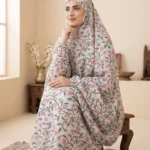 Premium Printed Lawn Namaz Chadar With Sleeves | Complete, Easy to Wear, Breathable and Non-see-through

This is the best namaz chadar with sleeves I've purchased. Stitching is neat, sleeves stay in place during sajdah and the print looks elegant after washing too.

بہت اچھی نماز چادر ہے۔ کپڑا ہلکا، آرام دہ
بہت اچھی نماز چادر ہے۔ کپڑا ہلکا، آرام دہ

I recieved my parcel safely. The namaz chadar lawn material feels soft and breathable. Reasonable for summer and easy to fold inside my handbag for travel.
I recieved my parcel safely. The namaz chadar lawn material feels soft and breathable. Reasonable for summer and easy to fold inside my handbag for travel.

Highly recomend.

Beautiful and great value for money floral print and very comfortable cotton fabric. The elastic under the chin keeps the chadar namaz in place throughout Salah without any adjustment.

I bought this for my mother before Umrah. She loved the full coverage and said it was much more comfortable than carrying a heavy abaya during prayers.

Bohat pyari namaz ki chadar hai. Allah Pak apko barkat de. 🤍
This namaz chadar with sleeves is exactly what I was looking for. The lawn fabric is soft, lightweight and doesn't see through and that matter the most
Why Namaz Chadar With Sleeves Buyers Trust Munawer.Pk
Imagine getting ready for your daily prayer with complete peace of mind, slipping into a soft, breathable wrap that stays perfectly locked in place from Takbeer to Salam. You deserve a seamless, comforting worship experience free from slipping scarves, exposed wrists, or suffocating summer heat. Munawer.Pk makes this worry-free, modest prayer routine a reality for Muslim women across Pakistan by offering genuine, export-grade lawn namaz chadar collections designed for true summer comfort.
Your Guide to Premium Full Coverage Prayer Wear
| What Matters to You | Munawer.Pk ✅ | Typical Online Sellers |
| Complete Body Coverage | ✅ Full-length namaz chadar (Length 52 and Chest 44 Inches), ensuring 100% opaque, full coverage namaz chadar protection that never lifts up during Ruku or Sujood | ⚠️ Short-length sheets that expose ankles or thin materials that become semi-transparent under light |
| Wrist & Arm Security | ✅ Stitched elasticated cuffs on our best namaz chadar with sleeves that stay secure during prostration and easily slide up for Wudu | ❌ Sleeveless designs or loose sleeves that constantly fall back and expose arms |
| Summer Heat Comfort | ✅ Made from 80% pure, breathable namaz chadar lawn to maximize airflow during humid days and power outages | ⚠️ Heavy synthetic polyester or georgette fabrics that cause extreme sweating and heat rashes |
| Open Box Confidence | ✅ Check your namaz chadar online pakistan order before paying on COD, supported by dispatch video verification | ❌ Sealed parcel delivery rules where you cannot verify fabric softness or stitching quality beforehand |
| Instant Slip-On Fit | ✅ Slip-proof 9.5 to 10 inch face opening with an elasticated chin band for an irani namaz chadar style fit that needs zero safety pins | ⚠️ Loose head openings that constantly slide off silky hair, forcing you to interrupt your prayer |
| Sunnah-Aligned Service | ✅ Transparent 7-day easy returns and exchange policy guided by Islamic business values | ❌ Unresponsive customer support with zero refund or return options after delivery |
| Heritage & Community Trust | ✅ 60+ years of family-owned retail experience with a 4.8-star rating from 7,481+ verified customers | ⚠️ Unverified new social media sellers with no physical backing or specialist experience |
| Honest Local Pricing | ✅ Direct manufacturer namaz chadar price in Pakistan with nationwide cash on delivery availability | ⚠️ Inflated retail prices for cheap, unstitched fabrics with hidden delivery charges |
Your daily Salah deserves absolute focus, total modesty, and pure physical comfort. Choosing our lightweight, pure namaz chadar cotton wrap eliminates the frustration of sliding dupattas and sticky summer heat, allowing you to focus entirely on your worship. Explore our latest namaz ki chadar online catalog at Munawer.Pk today, order your preferred namaz chadar with sleeves pakistan design, and experience what buying with complete, certified confidence actually feels like.
Eligibility for Returns:
You can request a return within 7 days from the date of delivery. To be eligible for a return, your item must be in the same condition that you received it, unworn or unused, with tags, and in its original packaging. You’ll also need the receipt or proof of purchase.
We recommend creating a video that showcases the unboxing of the product and provides an initial review.
Refund Process:
Upon approval of your return, we will initiate a refund to your original payment method. It may take a few business days for the funds to reflect in your account.
Return Shipping:
Customers are responsible for return shipping costs unless the return is due to a mistake on our part.
How to Request a Return:
To request a return, please contact our customer support team on WhatsApp at 0341 0738060 or email us at support@munawer.pk We will guide you through the process and provide you with the necessary instructions.
If your return is accepted, we’ll send you a return shipping label, as well as instructions on how and where to send your package. Items sent back to us without first requesting a return will not be accepted.
Damaged or Defective Items or Wrong Product or Never Arrived:
If you receive a damaged or defective item or the wrong product or product that never arrived, please contact us immediately with a video or photos of the product and its packaging. We will work to resolve the issue promptly. REMEMBER: YOU MUST MAKE VIDEO WHILE OPENING A PARCEL.
For more information Click here to visit: Refund and Refund Policy
Namaz Chadar with Sleeves — Slip On, Stand Up, and Pray in Seconds
You are at home in a light shalwar kameez when the azan plays, or guests arrive unexpectedly and you need to offer Salah immediately. A regular dupatta slides off your head before the first rakat is complete, a heavy abaya is too hot to pull on just for prayer, and pinning a scarf properly takes longer than the prayer itself. There has to be a better way to be instantly ready for Salah without adjusting anything mid-prayer.
Namaz Chadar in Printed Lawn — Cool, Opaque, and Always in Place
This namaz chadar with sleeves slips over your head like a hoodie in under ten seconds, with an elasticated chin band that locks the face opening in place and full elasticated sleeves that keep your wrists covered even during deep ruku and sujood. The fabric is 80% premium lawn, tightly woven to stay completely non-see-through despite being light as a feather, making it the ideal namaz chadar lawn for Pakistan's long, humid summers when heavier synthetic prayer garments become genuinely uncomfortable to wear. At 54 inches in front length and 60 inches at the back, the extended rear hem ensures full coverage during every prayer position without the chadar lifting.
Namaz Chadar for Women That Travels, Breathes, and Lasts
Picture praying Taraweeh in July without a single drop of sweat collecting under heavy fabric, or folding this lawn namaz chadar into your handbag before leaving home to use at a highway rest stop, office prayer room, or hotel room during travel. The elasticated wrist cuffs slide up instantly for wuzu and snap back into place in seconds, so your prayer routine stays uninterrupted from ablution to the final salaam. Available in soft pastel florals, polka dots, and elegant geometric prints, this namaz chadar for ladies looks modern and intentional rather than the plain white utility garment most people associate with prayer chadars. The universal free size fits heights 5'2 (Length 52 and Chest 44 Inches) comfortably; the cotton fabric is machine washable on a gentle cycle, and the interlocking seams hold through dozens of washes without fraying. Trusted by Pakistani women from Karachi to Peshawar as a Taraweeh essential, a Hajj and Umrah packing staple, and an everyday prayer companion that genuinely makes Salah simpler and more focused.
Namaz Chadar Lawn With Price
The current price of a full namaz chadar is 1599 Rs. It is important to note that this price may vary based on several external factors, such as changes in manufacturing costs, market demand, and economic conditions. This means that fluctuations in these factors could lead to an increase or decrease in the price of the namaz chadar Pakistan over time. Order your namaz chadar with sleeves online from Munawer.Pk today, with Cash on Delivery and fast delivery across Pakistan. Your prayer deserves full focus, not half your attention spent fixing a sliding dupatta.
Namaz Chadar With Sleeves — What Makes It Work
-
Acrylic lawn namaz chadar fabric → provides maximum airflow and rapid heat dispersion during hot summer prayers
-
Tightly woven opaque namaz chadar cotton material → ensures full modesty without needing an extra layer underneath
-
Loose stitched elasticated sleeves → keep wrists completely covered during Sujood while sliding up easily for Wudu
-
Extended 60-inch back length → prevents the full-length namaz chadar from lifting up during Ruku and prostration
-
Integrated 9.5-inch elastic chin band → locks the chadar namaz securely on the head without requiring pins
-
Single universal free-size (Length 52 and Chest 44 Inches) → offers an easy-fitting full coverage namaz chadar for heights between 5’2″
-
Interlocking double-stitched seams → withstand frequent machine washing without fraying, delivering exceptional long-term value
-
Compact lightweight roll-down design → packs into small travel bags for convenient daily use at offices or rest stops
-
Available across Pakistan via namaz chadar pk → delivers 100% original, verified quality at an affordable namaz chadar price
Verified authentic product sourced directly for buyers seeking namaz chadar in pakistan — available online exclusively at Munawer.Pk with fast home delivery.
Why Namaz Chadar With Sleeves Buyers Trust Munawer.Pk
Imagine getting ready for your daily prayer with complete peace of mind, slipping into a soft, breathable wrap that stays perfectly locked in place from Takbeer to Salam. You deserve a seamless, comforting worship experience free from slipping scarves, exposed wrists, or suffocating summer heat. Munawer.Pk makes this worry-free, modest prayer routine a reality for Muslim women across Pakistan by offering genuine, export-grade lawn namaz chadar collections designed for true summer comfort.
Your Guide to Premium Full Coverage Prayer Wear
| What Matters to You | Munawer.Pk ✅ | Typical Online Sellers |
| Complete Body Coverage | ✅ Full-length namaz chadar (Length 52 and Chest 44 Inches), ensuring 100% opaque, full coverage namaz chadar protection that never lifts up during Ruku or Sujood | ⚠️ Short-length sheets that expose ankles or thin materials that become semi-transparent under light |
| Wrist & Arm Security | ✅ Stitched elasticated cuffs on our best namaz chadar with sleeves that stay secure during prostration and easily slide up for Wudu | ❌ Sleeveless designs or loose sleeves that constantly fall back and expose arms |
| Summer Heat Comfort | ✅ Made from 80% pure, breathable namaz chadar lawn to maximize airflow during humid days and power outages | ⚠️ Heavy synthetic polyester or georgette fabrics that cause extreme sweating and heat rashes |
| Open Box Confidence | ✅ Check your namaz chadar online pakistan order before paying on COD, supported by dispatch video verification | ❌ Sealed parcel delivery rules where you cannot verify fabric softness or stitching quality beforehand |
| Instant Slip-On Fit | ✅ Slip-proof 9.5 to 10 inch face opening with an elasticated chin band for an irani namaz chadar style fit that needs zero safety pins | ⚠️ Loose head openings that constantly slide off silky hair, forcing you to interrupt your prayer |
| Sunnah-Aligned Service | ✅ Transparent 7-day easy returns and exchange policy guided by Islamic business values | ❌ Unresponsive customer support with zero refund or return options after delivery |
| Heritage & Community Trust | ✅ 60+ years of family-owned retail experience with a 4.8-star rating from 7,481+ verified customers | ⚠️ Unverified new social media sellers with no physical backing or specialist experience |
| Honest Local Pricing | ✅ Direct manufacturer namaz chadar price in Pakistan with nationwide cash on delivery availability | ⚠️ Inflated retail prices for cheap, unstitched fabrics with hidden delivery charges |
Your daily Salah deserves absolute focus, total modesty, and pure physical comfort. Choosing our lightweight, pure namaz chadar cotton wrap eliminates the frustration of sliding dupattas and sticky summer heat, allowing you to focus entirely on your worship. Explore our latest namaz ki chadar online catalog at Munawer.Pk today, order your preferred namaz chadar with sleeves pakistan design, and experience what buying with complete, certified confidence actually feels like.
Real Questions About Namaz Chadar With Sleeves — Real Answers
Q: Is the printed lawn namaz chadar with sleeves sold on Munawer.Pk 100% pure cotton and completely non-see-through?
A: It is made from 80% lightweight cotton and acrylic lawn that is tightly woven to remain completely opaque, printed, and non-see-through even under bright household lights.
Q: Will this full coverage namaz chadar fit me properly if I am short or tall?
A: This is a universal single-size full coverage namaz chadar engineered to fit women between 5’2″ height. The front length measures 54 inches, ensuring the hem never lifts up or exposes your feet during Ruku and Sujood. If you are under 5’2″, the fabric drapes comfortably over your feet without tripping you, and the elastic chin band ensures the face opening (9.5 to 10 inches) stays firmly in place regardless of head size.
Q: How do the stitched sleeves work for Wudu and prayer?
A: The best namaz chadar with sleeves features soft, loose-fitting elasticated cuffs that sit comfortably at your wrists during prayer to keep your arms fully covered during prostration. When it is time for Wudu, the flexible elastic allows you to quickly push the sleeves up past your elbows without stretching out the stitching or unpinning any fabric.
Q: Is this lawn namaz chadar convenient for hot Pakistani summers and Taraweeh?
A: Yes, the lightweight lawn namaz chadar is specifically crafted for Pakistan’s humid summer climate, load-shedding hours, and lengthy Taraweeh or Umrah prayers. Unlike heavy abayas or slippery georgette dupattas, the pure cotton fibers wick away sweat quickly and offer maximum airflow to keep you cool.
Q: Will the pure cotton shrink or fade after machine washing?
A: Pure cotton lawn can shrink up to an inch if exposed to boiling water or high heat, so always wash your chadar namaz in cold or lukewarm water on a gentle cycle. The soft floral prints are yarn-dyed to resist fading, but to keep the cotton crisp and long-lasting, avoid bleach, do not wring harshly, and line-dry in the shade before ironing on medium heat.
Q: How does this slip-on style compare to a traditional irani namaz chadar without sleeves?
A: Traditional irani namaz chadar options and a standard namaz chadar without sleeves require you to constantly hold the fabric shut with your hands or secure it with safety pins to avoid slipping off during prayer. This stitched sleeve design slips on instantly like a hoodie, locking onto your head with an elastic chin band and keeping your hands free so you can focus entirely on your Khushu in Salah.
Q: How much does a namaz chadar price in Pakistan usually run, and how fast is delivery from Munawer.Pk?
A: The namaz chadar price in pakistan varies by fabric quality, but pure lawn stitched variants offer the best balance of durability and comfort. Standard Cash on Delivery (COD) orders across Pakistan arrive at your doorstep in 4 to 6 working days, and at Munawer.Pk, you can open and verify your parcel before paying on COD. For urgent needs, we also offer fast overnight air shipping for prepaid orders, delivering within 2 to 3 working days (Sundays excluded).
Q: What is a namaz chadar and what is its role in a woman’s prayer routine?
A: A namaz chadar is a dedicated prayer covering worn by Muslim women during salah to fulfill the Islamic requirement of covering the awrah (the parts of the body that must be covered during prayer). It is a loose, flowing garment like abaya or an irani chadar — designed to cover the entire body from head to foot except the face and hands, ensuring that a woman can offer her prayers with complete modesty and without the distraction or concern of checking whether her regular clothing provides adequate coverage.
Q: What type of namaz chadar is most suitable and modest for ladies?
A: The most suitable and modest namaz chadar for ladies combines complete coverage, ease of wearing, and practical comfort during the physical movements of prayer:
- Full-length design covering from head to ankles or floor-length with no gaps in coverage during all prayer positions including ruku and sujood
- Sleeve coverage that keeps the arms covered during all positions — particularly important during ruku when a sleeveless chadar may cause the arms to become exposed
- Secure head coverage that stays in place without constant readjustment — a fitted or elasticated head opening or a makhna-style attached headpiece significantly improves stability
- Adequate width and fullness so that when kneeling in sujood the back does not become exposed and the feet remain covered in the sitting position
- Opaque fabric that doesn’t become see-through in bright light or when stretched — double-layered or thick enough fabric prevents transparency during prayer
For Pakistani women specifically, a lawn or cotton full-length chadar with sleeves and a secure head opening is the most commonly preferred choice for daily home prayer use throughout most of the year, shifting to thicker fabrics in winter months.
Q: What should women look for when choosing the right namaz chadar for daily prayers?
A: The key selection criteria for daily use:
Coverage:
- Length should reach the ankles or floor — no gap of skin showing at any position
- Width should be generous enough that kneeling and prostrating doesn’t create pulling that shortens the back coverage
- Head coverage should be secure and complete
Practicality:
- Easy to put on and take off quickly — a woman offering five daily prayers needs to wear and remove the chadar multiple times throughout the day
- Machine washable — daily use demands easy maintenance
- Wrinkle-resistant — a chadar that requires ironing before every prayer creates a practical barrier to consistent prayer use
Comfort:
- Breathable fabric appropriate to the season — cotton or lawn for summer; light wool or flannel for winter
- Lightweight enough that it doesn’t feel cumbersome during the physical movements of prayer
- Not too loose that it constantly needs readjustment during ruku and sujood
Modesty:
- Completely opaque in all lighting conditions
- No decorative elements that distract during prayer
- Neutral or modest colors and designs appropriate for worship
Q: What is the difference between a namaz chadar with sleeves and one without sleeves?
A: The difference is primarily functional and relates to coverage during the movements of prayer:
Namaz chadar with sleeves:
- Has stitched sleeves (full-length) that keep the arms covered regardless of how the arms are raised or positioned during prayer
- Provides secure, reliable arm coverage during all prayer positions — qiyam (standing), ruku (bowing), sujood (prostration), and sitting
- More like a full prayer garment that can be worn without checking coverage
- Better suited for daily use since it requires no additional adjustment for arm coverage
- Slightly warmer due to additional fabric coverage
Namaz chadar without sleeves:
- A draped or wrap-style covering without stitched sleeves; the arms are covered by the fabric falling over them when the arms are at the sides
- Coverage of the arms can become unreliable when the arms are raised during prayer — particularly during the opening takbeer (hands raised to ears) and during ruku
- Requires the wearer to ensure adequate arm coverage through the draping technique
- Simpler construction; often less expensive
- May be suitable for women who wear long-sleeved clothing underneath and only need the chadar for head and body coverage
For reliable and complete coverage during all prayer positions, the sleeved version is the more practically complete choice for most women.
Q: What makes a namaz chadar with sleeves a better choice for daily prayer use?
A: (Already answered above — sleeves provide reliable arm coverage through all prayer positions without requiring adjustment or management of fabric draping during the physical movements of salah.)
Q: Is a namaz chadar without sleeves acceptable for prayer and who is it most suitable for?
A: A sleeveless namaz chadar is acceptable for prayer provided the arms and all other required areas remain covered throughout all prayer positions. If the woman is wearing a full-length, long-sleeved garment underneath the chadar, the sleeveless chadar provides the additional coverage for the rest of the body and head while the underlying clothing handles arm coverage. It is most suitable for:
- Women who wear full-length, long-sleeved daily clothing (like a loose abaya or long kurta with sleeves) who only need the chadar for head and outer coverage
- Warmer climates where minimizing fabric layers is a comfort consideration
- Travel use as a lighter-weight, more compact packing option when the underlying clothing is already adequately covering
Q: What are the benefits of wearing a full-length namaz chadar during prayers?
A: A full-length namaz chadar — one that covers from the crown of the head to the feet — provides comprehensive benefits for prayer:
Religious completeness:
- Ensures the awrah is fully covered in all positions without any risk of exposure at the ankles, wrists, or back
- Provides confidence and peace of mind during prayer — the woman can focus entirely on the spiritual engagement of salah rather than concerns about coverage
- Fulfills the scholarly consensus on the required coverage for women’s salah without any ambiguity
Practical benefits:
- Works as a complete prayer covering over any type of everyday clothing — the woman doesn’t need to be already wearing specific prayer-appropriate clothing
- Allows women to quickly transition from any activity to prayer without a full wardrobe change
- Covers potential gaps in coverage that might exist in the woman’s regular clothing during the physical movements of prayer
Q: Why is a full coverage namaz chadar preferred for offering prayers at home or in a mosque?
A: (Already answered above.)
Q: What is a namaz chadar with niqab, and is it necessary to cover the face during prayer?
A: A namaz chadar with niqab is a prayer covering that includes an attached face veil in addition to the standard body covering. Regarding the Islamic ruling on covering the face during prayer:
The scholarly consensus: Covering the face is not required during prayer according to the majority of Islamic scholars. The face is not part of the awrah that must be covered during salah — a woman praying with her face uncovered is offering a valid, complete prayer.
Why some women choose a chadar with niqab:
- Women who observe niqab as part of their regular practice may feel more spiritually comfortable maintaining face covering during prayer as well, even though it is not required
- In congregation or mixed settings, some women prefer the niqab attachment for additional modesty if non-mahram men might be present
- Cultural practice in some Pakistani, Iranian, and Afghan communities where niqab during prayer is traditional
The scholarly position clearly stated: The face and hands are exempt from the awrah requirements during salah — a woman’s prayer is fully valid and complete with the face uncovered. Wearing a niqab during prayer is a personal choice and a supererogatory act of modesty, not a religious requirement.
Q: What is the difference between a namaz chadar and a prayer abaya?
A: Both serve the purpose of covering a woman completely during salah, but they differ in design and construction:
Namaz chadar:
- A draped or loosely structured covering — more like a large shawl or wrap, sometimes with minimal stitching
- Put on by wrapping or draping over the head and body
- Generally simpler in construction — often a single piece of fabric with a head opening or two-piece design
- More portable and compact for travel
- Traditional in Pakistani and South Asian Muslim culture
- Often worn over everyday clothing
Prayer abaya:
- A fully stitched open-front or pullover garment resembling a robe
- More structured with proper sleeves, a fitted or loose silhouette, and a formal garment construction
- Provides secure, reliable coverage with the structure of a stitched garment
- More common in Gulf Arab countries and increasingly popular in Pakistan
- Generally more expensive due to greater fabric and construction requirements
- Often comes in black though other colors are available
Both fulfill the same religious function when correctly designed — the choice between them is primarily cultural preference, comfort, and personal style.
Q: What is the difference between a jilbab and a namaz chadar for prayer use?
A: A jilbab and a namaz chadar serve overlapping but distinct purposes:
Jilbab:
- A loose, full-length outer garment worn in public as part of daily Islamic modest dress
- Mentioned in Quran (Surah Al-Ahzab 33:59) as the outer covering Muslim women should wear when going out
- Designed as an outer garment covering the entire body for public use
- Can be a coat-style, abaya-style, or wraparound garment depending on regional interpretation
- Worn outside the home as regular modest dress — not exclusively for prayer
Namaz chadar:
- Specifically designed for the purpose of prayer
- A home prayer garment — typically kept near the prayer space and worn specifically for salah
- Not necessarily designed for public outdoor wear
- Simpler in design — prioritizes complete coverage during prayer positions over everyday outdoor fashion considerations
Overlap: A jilbab that provides full coverage of the awrah is perfectly valid to pray in — many Pakistani women offer salah in their jilbab or abaya without needing to add a separate namaz chadar. The namaz chadar is a convenient, specifically designed alternative for women whose everyday clothing doesn’t fully fulfill prayer coverage requirements.
Q: Why is cotton considered one of the best fabrics for a namaz chadar?
A: Cotton earns its status as the preferred namaz chadar fabric through several properties ideally suited to prayer use:
Breathability: Cotton’s natural fiber structure allows air circulation, keeping the wearer comfortable during prayer in warm Pakistani summers when additional layers can cause overheating — particularly important during the longer prayers of Fajr and Isha
Skin comfort: Cotton is gentle against the skin and face — the area of the chadar near the face must be comfortable since any irritation distracts from prayer focus
Absorbency: Natural cotton absorbs perspiration during prayer, keeping the wearer dry and comfortable
Opaqueness: Good quality cotton is reliably non-transparent, ensuring coverage is complete in all lighting conditions without the transparency risk of some synthetic fabrics
Easy care: Cotton is machine washable, can be washed at higher temperatures for hygiene, and responds well to ironing — practical for a daily-use item
Year-round adaptability: Lighter cotton weaves work well in summer; heavier cotton and cotton blends provide warmth in winter
Absence of static: Unlike synthetic fabrics, cotton doesn’t generate static electricity that causes the chadar to cling to the body during prayer movements
Q: What are the benefits of choosing a lawn fabric namaz chadar for summer use?
A: Lawn fabric — the fine, lightweight cotton weave that is Pakistan’s most beloved summer textile — is particularly well-suited for summer prayer covering:
Temperature management: Lawn’s fine, open weave allows maximum air circulation, making it the coolest cotton option for summer prayer use — critical during Pakistan’s intense summer heat when temperatures in cities like Multan and Lahore regularly exceed 40°C
Lightweight feel: The lightness of lawn means the additional covering layer of a chadar feels minimal rather than burdensome in hot weather — encouraging consistent prayer observance even in extreme heat
Moisture management: Lawn absorbs sweat effectively and releases it quickly to the air, keeping the wearer feeling fresh even through multiple daily prayers
Softness: Quality lawn has an exceptionally soft hand feel that is comfortable against the face and skin
Pakistan-specific advantage: Lawn is the most widely available quality fabric in Pakistan’s textile market — available in countless colors, patterns, and qualities at a wide range of price points; namaz chadars in lawn are among the most accessible and affordable high-quality prayer garments available in the Pakistani market
Easy washing: Lawn washes easily by hand or machine, maintains its softness, and dries quickly — ideal for a daily-use prayer garment in summer
Q: What is a makhna namaz chadar and what makes it suitable for prayer?
A: A makhna is a specific headpiece design — a fitted, bonnet-like covering that covers the head, ears, and nape of the neck, typically made from the same fabric as the accompanying chadar or as a standalone piece. In namaz chadar context, a makhna chadar refers to a prayer set that includes a makhna headpiece used in combination with a body covering chadar.
What makes a makhna particularly suitable for prayer:
- Secure head coverage: Unlike a loose dupatta or draped chadar that can slip during the bowing of ruku or the repetitive movements of prayer, a makhna fits snugly and stays in place throughout all prayer positions without any manual readjustment
- No pins required: The fitted structure of the makhna means no safety pins are needed to keep it in place — eliminating the risk of pins opening during sujood and causing injury
- Complete neck coverage: The makhna covers the nape and hairline completely — an area that can be exposed when a simple dupatta is used as a head covering during prayer
- Convenience: Simply placing the makhna on the head provides instant, secure head coverage without the draping or arrangement required for a dupatta or loose chadar
- Popular in Pakistan: Makhna-style headpieces are extremely popular in Pakistani women’s prayer wear — widely available in markets and online and considered one of the most practical solutions for consistent head coverage during salah
Q: What is an Irani namaz chadar and how is it different from a regular prayer chadar?
A: An Irani namaz chadar (also called Irani chador) is a specific style of prayer covering closely associated with the full-body chador traditionally worn in Iran. Its defining characteristics:
Design:
- A large semicircular or full circular piece of fabric — no stitching except at the opening
- Worn by holding the front edges together under the chin or in the hands, or with a pin
- Covers from the crown of the head to the floor, enveloping the entire body
- No sleeves — the arms are covered by the draping fabric
- Typically in solid dark colors — black, navy, or dark grey — often in a light synthetic fabric with a slight sheen
Differences from regular Pakistani namaz chadar:
- The Irani style uses a single large piece of fabric without any body shaping or fitted elements
- Requires the hands or a pin to keep it closed at the front during non-prayer activity
- During prayer, the edges are tucked or pinned to allow hands-free movement
- More enveloping — covers more completely than many Pakistani-style chadars
- Less structured — doesn’t have the tailored elements of stitched Pakistani prayer garments
Availability in Pakistan: Irani namaz chadars are available at Islamic supply shops and on Daraz — they are popular among Pakistani women who prefer the fuller coverage and simpler design, and are often chosen for mosque use and for Umrah and Hajj.
Q: What is the standard cutting pattern of a namaz chadar for proper coverage?
A: The standard cutting patterns used for namaz chadars in Pakistan fall into a few common formats:
Two-piece stitched chadar:
- Headpiece (makhna): A fitted bonnet-style piece cut to cover the head, ears, and nape; typically an oval or rounded rectangle with elastic or tucks to create the fitted shape
- Body piece: A long rectangular panel approximately 2.5 to 3 meters long and 1.5 to 1.8 meters wide, gathered or pleated at the top to attach to the head piece; full length to floor
One-piece draped style:
- A single large rectangle or semicircle of fabric (approximately 2 to 2.5 meters × 1.5 meters) with a central head opening cut or hemmed into the fabric; no separate head piece
Full stitched garment style (similar to abaya):
- A pullover or wrap-around stitched garment with set-in sleeves and a head opening; more structured and tailored than the draped alternatives
- Pattern includes front and back body panels, full-length sleeves, and a hood or attached head covering
The critical measurement principle: In all patterns, the key measurement is that the body panel must be long enough and wide enough that when the wearer is in the sujood position — the most physically demanding coverage position — the back does not become exposed and the chadar does not pull tight across the back and shorten the front.
Q: What are the correct cutting and stitching measurements for a namaz chadar?
A: Standard measurements used by Pakistani tailors and ready-made manufacturers:
For a two-piece makhna-style set:
Makhna (headpiece):
- Length: 50 to 55cm (from forehead to below the nape of neck)
- Width: 40 to 45cm (ear to ear across the top)
- The piece is cut in an oval or elongated shape and gathered with elastic or tucks at the back to create a fitted bonnet shape
Body chadar panel:
- Length: 120 to 135cm for most average heights (floor-length measurement from shoulder)
- Width: 150 to 180cm (to ensure adequate fullness for movement without tightness)
- Attached to the makhna at the shoulder/nape line with gathering to create fullness
For a full one-piece chadar with hood:
- Total fabric length: 220 to 250cm
- Width: 150 to 160cm
- Head opening: 52 to 55cm circumference, centered in the fabric approximately 60 to 70cm from one end
- Sleeves (if included): Standard full-length sleeve approximately 60cm in length and 36 to 40cm width at the cuff
Important tailoring note: Always cut for full sujood coverage — measure the wearer’s back length from the top of the head to the floor when in sujood position, not just standing height, to determine the minimum required chadar length.
Q: How is a namaz chadar stitched to ensure full coverage and ease of wearing?
A: Key stitching considerations for a properly constructed namaz chadar:
Head opening: The head opening should be finished with a narrow hem or facing — not a raw edge that frays — and sized comfortably snug so it doesn’t slip during prayer but not so tight it is uncomfortable
Makhna attachment: When a separate makhna is included, it should attach to the body chadar at the shoulder level with secure, flat seaming that lies smooth and doesn’t create a bulky ridge that irritates the neck
Hem finishing: All hems — particularly the floor-length hem of the body panel — should be double-turned and machine stitched for durability, as this hem drags on the floor during prayer and receives significant wear
Sleeve setting: Sleeves must be set in with enough ease at the armhole that the arm can be fully raised (as in the opening takbeer) without pulling the chadar up from the body
No elastic at body: Avoid elastic at the waist or body level — elastic creates tightness that pulls the chadar during movement and can cause the back to become short in sujood
Allowance for sujood: The most important structural consideration — the back panel must have sufficient length that kneeling forward in full sujood doesn’t pull the back of the chadar tight and expose the ankles or feet
Q: What fabric is best for namaz chadar?
A: (Already answered — cotton and lawn are the best fabrics for summer use; flannel, light wool, or cotton blends work better for winter. The key requirements for any namaz chadar fabric are opacity, breathability, skin comfort, and washability.)
Q: How do you wear a namaz chadar properly?
A: The correct wearing method depends on the style:
For a two-piece makhna and chadar set:
- Place the makhna on the head like a bonnet, ensuring all hair is tucked in and the ears and nape of neck are fully covered
- Drape the body panel over the makhna, ensuring it falls evenly on all sides
- Check that the front, back, and sides all reach the floor or ankle level
- Perform a quick coverage check — raise arms as if in takbeer, bow forward as in ruku, and check that no skin or hair is visible at any point
For a one-piece chadar with central head opening:
- Place the head opening over the head, settling it comfortably at the hairline
- Arrange the fabric so coverage falls evenly — front panel and back panel approximately equal length
- If the chadar has sleeves, insert arms; if no sleeves, arrange fabric over the arms
- Pin at the chest if the front tends to open
For an Irani-style chador:
- Hold the fabric at the center of the top edge
- Place the top edge at the hairline and drape the fabric over the head and shoulders
- Hold the front edges together under the chin or pin at the collarbone
- Ensure the fabric reaches the floor all around
Q: Is it necessary to wear a namaz chadar for prayer?
A: It is not specifically the namaz chadar as a garment that is required — what is required by Islamic law is that a woman’s awrah is fully covered during prayer. The awrah of a woman in prayer (according to the Hanafi school predominant in Pakistan) is the entire body except the face and hands. A namaz chadar is one convenient way to fulfill this requirement — but it is not the only valid way. A woman praying in clothing that already covers her completely — a loose abaya, a full-length jilbab with long sleeves, or appropriately covering everyday clothes — is fulfilling the prayer’s coverage requirement without needing an additional chadar.
Q: What is the difference between a namaz chadar and a prayer abaya?
A: (Already answered — refer to “What is the difference between a namaz chadar and a prayer abaya?” above.)
Q: How do you wash and care for a namaz chadar?
A: A namaz chadar requires regular washing given its daily use in close contact with the face and body:
Washing:
- Cotton and lawn chadars: Machine washable on a gentle or regular cycle at 30 to 40°C; use mild fragrance free detergent to avoid skin reactions from residual fragrance against the face during prayer
- Wash with similar colors — prayer chadars in white or light colors should never be washed with dark clothing
- Do not bleach unless the chadar is white and the fabric care label permits — bleaching weakens cotton fibers over time
Drying:
- Air dry flat or on a hanger away from direct intense sunlight — prolonged sun exposure fades colors and weakens fabric
- Cotton and lawn dry quickly in Pakistan’s climate — usually within a few hours outdoors
Ironing:
- Most cotton and lawn chadars benefit from ironing — a smooth, unwrinkled chadar drapes better during prayer and provides more reliable coverage than a heavily wrinkled one
- Iron at the appropriate temperature for the fabric type
Storage:
- Fold neatly and store in a clean, covered location near the prayer area
- Keep away from perfume, incense, or cooking smells that would make the chadar strongly scented — some scholars advise keeping prayer garments free of strong fragrances
Q: What is the namaz chadar size guide?
A: Our namaz chadar size is Length 52 and Chest 44 Inches
Q: Can you use a dupatta instead of a namaz chadar for prayer?
A: A dupatta can be used for prayer provided it fulfills the coverage requirements — meaning it covers the head, neck, and enough of the body and arms that the awrah is not exposed in any prayer position. The practical challenges with using a dupatta as a prayer covering:
Coverage limitations:
- A standard dupatta typically covers the head and shoulders but leaves the arms, back, and lower body uncovered — making additional clothing coverage essential
- During ruku and sujood, a dupatta slips and shifts easily, potentially exposing the hair or neck
Practical challenges:
- Requires constant readjustment during prayer — distracting from spiritual focus
- Generally less reliable than a dedicated prayer chadar for maintaining coverage through all positions
When a dupatta is acceptable:
- If the woman is already wearing fully covering clothing (long sleeves, ankle-length garments) and only needs the dupatta for head coverage — this is a valid approach
- If the dupatta is large enough to drape over the head and body adequately
The scholarly guidance: What matters is coverage, not the specific garment used. A dupatta that fulfills the coverage requirements is valid; one that doesn’t is insufficient regardless of being a traditional garment.
Q: What is the Islamic ruling on wearing a namaz chadar in Islam?
A: The Islamic ruling on women’s prayer covering is well-established across all major schools of jurisprudence:
The requirement: A Muslim woman must cover her entire body except the face and hands during salah. This is a shart (condition) of the validity of salah — meaning prayer offered with the awrah uncovered is not valid and must be repeated.
The evidence: This ruling is established through the hadith of the Prophet ﷺ who said: “Allah does not accept the prayer of a woman who has reached puberty unless she is wearing a khimar (head covering).” (Reported in Abu Dawud, Tirmidhi, and Ibn Majah)
The namaz chadar specifically: The namaz chadar is a practical tool for fulfilling this requirement — it is not mentioned by name in the Quran or Sunnah as a required garment, but as a means of fulfilling the established coverage requirement it is both valid and recommended
Hanafi position (predominant in Pakistan): The awrah in prayer for a free Muslim woman is the entire body except the face, both hands to the wrists, and the feet according to some scholars (though many Hanafi scholars include the feet in the awrah, requiring coverage to the ankles)
Practical implication for Pakistani women: Having a dedicated namaz chadar available and using it consistently for all five daily prayers is a simple and reliable way to ensure the validity of every prayer — making it one of the most practically important items in a Muslim woman’s home.
Premium Printed Lawn Namaz Chadar With Sleeves | Complete, Easy to Wear, Breathable and Non-see-through
This is the best namaz chadar with sleeves I've purchased. Stitching is neat, sleeves stay in place during sajdah and the print looks elegant after washing too.
بہت اچھی نماز چادر ہے۔ کپڑا ہلکا، آرام دہ
بہت اچھی نماز چادر ہے۔ کپڑا ہلکا، آرام دہ
I recieved my parcel safely. The namaz chadar lawn material feels soft and breathable. Reasonable for summer and easy to fold inside my handbag for travel.
I recieved my parcel safely. The namaz chadar lawn material feels soft and breathable. Reasonable for summer and easy to fold inside my handbag for travel.
Highly recomend.
Beautiful and great value for money floral print and very comfortable cotton fabric. The elastic under the chin keeps the chadar namaz in place throughout Salah without any adjustment.
I bought this for my mother before Umrah. She loved the full coverage and said it was much more comfortable than carrying a heavy abaya during prayers.
Bohat pyari namaz ki chadar hai. Allah Pak apko barkat de. 🤍
This namaz chadar with sleeves is exactly what I was looking for. The lawn fabric is soft, lightweight and doesn't see through and that matter the most
Eligibility for Returns:
You can request a return within 7 days from the date of delivery. To be eligible for a return, your item must be in the same condition that you received it, unworn or unused, with tags, and in its original packaging. You’ll also need the receipt or proof of purchase.
We recommend creating a video that showcases the unboxing of the product and provides an initial review.
Refund Process:
Upon approval of your return, we will initiate a refund to your original payment method. It may take a few business days for the funds to reflect in your account.
Return Shipping:
Customers are responsible for return shipping costs unless the return is due to a mistake on our part.
How to Request a Return:
To request a return, please contact our customer support team on WhatsApp at 0341 0738060 or email us at support@munawer.com We will guide you through the process and provide you with the necessary instructions.
If your return is accepted, we’ll send you a return shipping label, as well as instructions on how and where to send your package. Items sent back to us without first requesting a return will not be accepted.
Damaged or Defective Items or Wrong Product or Never Arrived:
If you receive a damaged or defective item or the wrong product or product that never arrived, please contact us immediately with a video or photos of the product and its packaging. We will work to resolve the issue promptly. REMEMBER: YOU MUST MAKE VIDEO WHILE OPENING A PARCEL.
For more information Click here to visit: Refund and Refund Policy